 Boxer
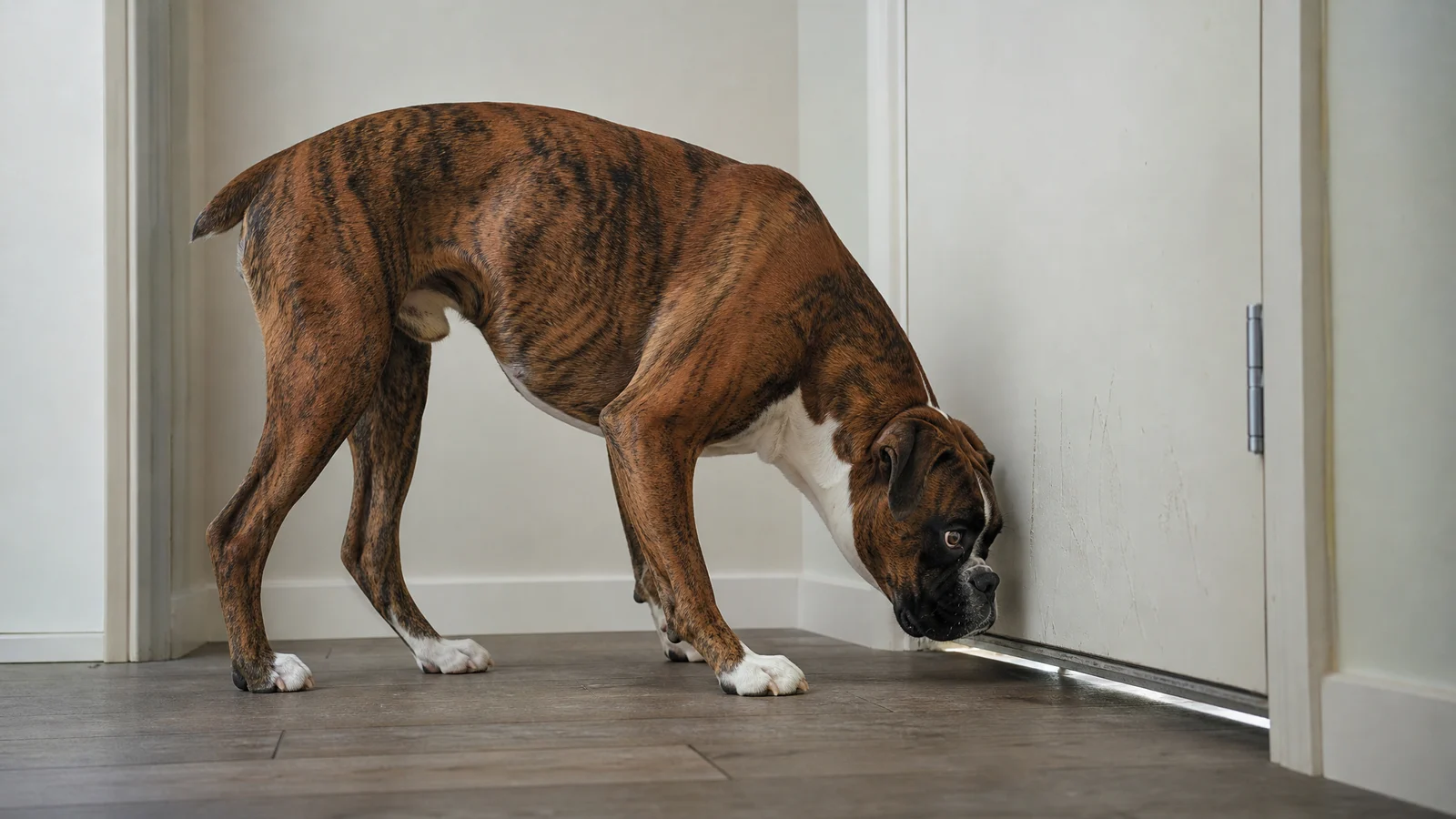
A Boxer who falls apart when the door closes is not being stubborn or spiteful, and shutting them away for longer will not teach them otherwise. What works is practice that starts at an absence so short your dog barely notices it, then grows only as fast as they can keep up.
Boxers are family dogs through and through: affectionate, playful and happiest in the middle of whatever is going on. They also have quick minds and plenty of energy, so an empty house hands a Boxer both a loss and a lot of spare capacity to do something about it. Neither half is a flaw, but both need planning.
Read on for how to tell real distress from plain boredom and how to cover the hours you cannot train. After that comes the step-by-step practice itself.
Where Boxer Separation Anxiety Tends to Start
Before you change anything, it helps to know what usually sets a dog up to struggle with an empty house. The cause often points at the first fix, and with a Boxer the story starts with how tied they are to their household. These all appear among the risk factors for separation anxiety on a Texas A&M veterinary college page:
- A change of ownership
- A shift in family routine or schedule
- A move to a new house
- The loss of a family member
Most of those are changes to a household, which makes the first useful question simply what has changed lately. Boxers bring their own ingredients too. As Boxer people, we know the breed as clever, active and bored by repetition, with a body that wants something to do and a heart that wants to do it beside you. When that dog is alone, closeness has nowhere to go and energy has nothing to land on.
Telling Panic From Boredom in a Boxer Left Alone
A chewed doorframe or a complaint from the neighbors can come from several places, and only some of them are separation distress. Getting this call right saves weeks of practice aimed at the wrong problem. The result looks different from one Boxer to the next. Some panic, pacing and calling for you, while others simply take the living room apart, and from the hallway the two can look alike. They need different answers, so sorting them comes first.
The ASPCA points out that bored dogs can be disruptive when left alone but usually don't appear anxious, while the chewing, digging and destruction of a dog with separation anxiety don't usually occur in their guardian's presence. That hands you a simple first test: does the trouble show up only when you are gone?
Signs That Point to Distress
No single sign settles the question, but these patterns lean toward distress rather than boredom or habit. Look for several of them together:
- Timing: the noise, pacing or damage begins soon after you leave and is rare when someone is home with your dog.
- Trouble at the exits. Scratching, chewing or digging gathers around doors and windows, the places you disappeared through.
- Soiling only when you are gone in a Boxer who is reliably house trained the rest of the time points away from a simple training gap.
- Worry before you leave: your Boxer shadows you closely, trembles or pants as you reach for your keys, and does not seem to enjoy their food or toys once you are gone.
If most of those fit, treat the problem as distress and keep reading. If only a few do, extra exercise, brain work and better chew items may be most of what you need, and a young Boxer who chews while you are home as well is mostly just being a young Boxer.
Seeing Your Vet First
Either way, book a vet visit before starting any plan if the behavior is new or sudden, if there is soiling, or if your Boxer seems unwell in any way. Only an exam can rule out a physical cause, and no amount of practice will fix a problem that is not behavioral.
Covering the Hours Your Boxer Cannot Be Alone Yet
Sorting the cause is the first half of the work. The second half is making sure your Boxer is not rehearsing panic between lessons, because a long, frightening absence can undo a lot of what a short, easy one built. That means covering any stretch longer than your dog currently handles. A family member, a friend, a pet sitter or a daycare can take those hours, and a change to your own schedule can help for the weeks the training runs.
It is a lot of juggling, so think of it as temporary rather than the new normal. Set up a camera or a pet monitor as well. Watching even a few minutes of an absence shows you when the trouble starts and whether your Boxer settles, which is far more reliable than guessing from the state of the house when you walk in. Check that the area is safe too, since an athletic, inventive dog can get through a gate or around a door frame faster than you would expect.
If you are wondering about a crate, treat that as a separate question from the anxiety. Resting in a crate while you are in the room is a different skill from coping when you leave, and our guide to crate training a Boxer covers the setup so it does not need repeating here.
A Calm Boxer When Alone Begins With a Mat
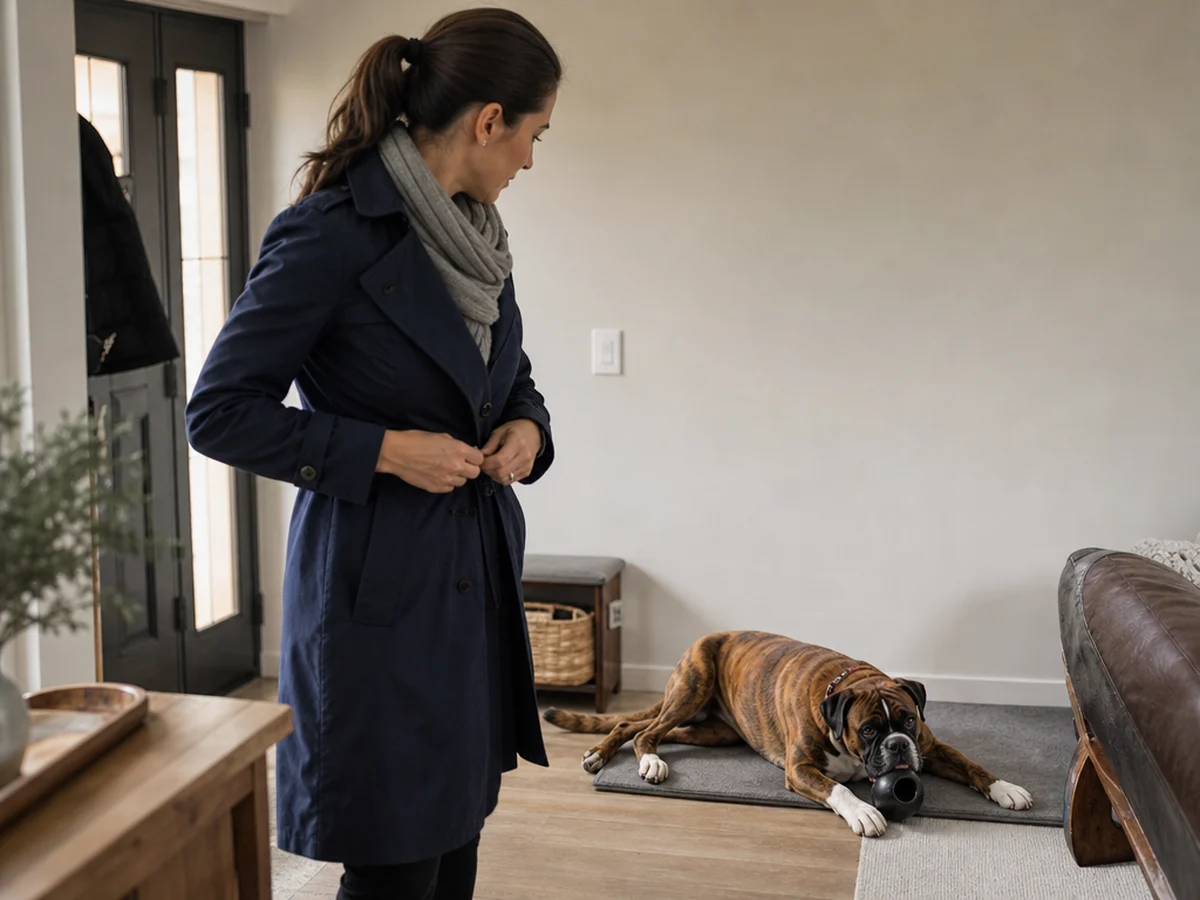
Cover buys you time, so here is how to spend it. Before the first real practice, give your Boxer a place to settle, a body that has had its outlets and a leaving routine that carries no alarm.
Teaching the Mat as a Settle Spot
Put a mat or bed where your Boxer can see family life without being in the middle of it. Reward every step onto it, then every time they lie down, then calm breathing and a relaxed body for a little longer each time. Keep sessions short and change the treats and the room now and then, since a clever Boxer gets bored by repetition faster than you might like.
The mat should come to mean that nothing is required except resting. If you need a refresher on rewarding stillness, our Boxer sit and stay basics cover the building blocks.
Spending Energy Before Practice
A Boxer who has run, sniffed and worked on a food puzzle tends to settle more easily than one who is still wound up. Plan the big outing and some brain work ahead of a practice session, then give your dog time to drink, cool off and rest before you begin.
Exercise supports the training but does not replace it, because a tired dog can still worry once the door shuts. Regular check-ups with your vet also help here, since they tell you what is normal for your Boxer's energy and rest.
Making Departure Cues Dull
Dogs read the order of events: shoes, keys, coat, bag, door. If that sequence has always meant you are gone, your Boxer may be upset before you have even left. Break the link by performing pieces of it when you are staying. Pick up the keys and put them down, put on your jacket and make a sandwich, carry the bag to the couch. Do it at random moments, without a goodbye, until the signals stop predicting anything.
Alone Training for a Boxer in Small Steps
With the mat, the outlets and the dull cues in place, the real teaching can start. The ladder below has four rungs, and each one comes with a test for moving on and a fix for when your Boxer stalls. Spend as long as you need on every rung, because skipping one is an easy way to lose the progress you have made.
Settling With You in the Room
Start with you at home and your dog on the mat. Sit nearby with a book, pay calm lying down every so often, then stand up and sit back down. Walk across the room and return before your Boxer gets restless, and pay for staying on the mat.
Move on when your Boxer stays settled smoothly several times in a row while you walk around the room. If they follow you, make your walks shorter and pay on the mat more often, since the goal at this rung is a dog who trusts that you will return.
Out of Sight Inside the House
Next, add a barrier: a gate across a doorway, or a door you can step behind. Give a food-stuffed toy, step out of sight for a moment, then come back and quietly reward your dog before they finish. Vary the lengths so they cannot predict them, with a short one, a slightly longer one, then an easy one again. Move on when your Boxer greets your return calmly and carries on resting or chewing while you are out of sight.
If they cry, shorten the next absence and make the toy better. Where you can, return during a quiet moment rather than in the middle of a long wail.
The Door Itself
The front door is where the real alarm lives, so it gets its own rung. In the SF SPCA's alone-time training game, the dog holds a stay with a few treats on the floor out of reach, the person walks out, and the release comes as the door closes.
Before that, the steps go from walking up to the door to touching and rattling the knob, then opening and closing it, then going part way and finally completely through with the door left open. Each dog moves through them at their own pace.
Here is how one practice round runs with your Boxer. Keep every round this small until your dog stops noticing it:
- Ask your Boxer to settle on the mat or near the door, and let them see a few treats go on the floor in front of them.
- Do one small door step, such as walking to the door or touching the knob, then come straight back.
- Release your dog to the treats while you are still close enough that the whole thing feels easy.
- Repeat the same step until your Boxer barely looks up, and only then make the next step a little bigger.
Move on when every door step, including leaving with the door open, passes without your Boxer getting up or worrying. If they stall, go back one step and make it smaller, and try a better treat or a calmer time of day.
Stretching the Time
Now close the door behind you, first for only a few seconds, then slightly longer, mixing easy short ones in with longer ones. Leave a long-lasting food toy as you go and come back before it is finished. Practice at relaxed moments, not right before a real departure, so the practice does not get tangled up with the real thing. When closing the door is easy, step outside, then walk to the car and back, then start the engine, then drive to the end of the street.
Use the camera for each new step and watch your Boxer rest. Stretch the time only when your dog is still resting at the end of the last one.
When a Boxer's Alone Practice Slips Backward
Even a smooth ladder has off days. A real absence, a missed nap or a rung taken too fast can send a Boxer back a step, and when it does, the fix is to make the next session easier.
The more serious signal is a dog who does not settle at all. If your Boxer cannot manage even a short departure, or shows distress at any point, the sensible move is to stop the exercises and consult a veterinary behaviorist, because some dogs become sensitized instead of desensitized, growing distressed more and more quickly, and further training can be detrimental. Until you have that help, keep covering every absence with a sitter, family member or daycare.
Never scold when you come home to damage, since a scolding can add to the worry the next time you leave. If your Boxer also chews while you are home, that is a separate problem, and our page on Boxer chewing problems covers it.
Boxer Owner Questions Once Practice Is Underway
Closeness runs through the next three questions: where your Boxer follows you, how they greet you and what they do with the energy you hand them. Each one is a small detail that can decide whether a day of practice goes smoothly.
Why does my Boxer shadow me everywhere?
Following you around is what a devoted dog does when you are home, and it only becomes a problem if your Boxer cannot cope when the following stops. Pay for settling on the mat while you move about, and use a gate across a doorway for short stretches so they can watch you carry on from the other side.
How should I greet my Boxer on returning?
Keep it brief and quiet, and wait for the bouncing to slow before you pet. If the welcome is a leap, our page on calmer Boxer greetings shows how to reward four feet on the floor.
Is a long run before I leave enough?
A run helps a Boxer rest, and it is worth doing, but it works best alongside practice, not instead of it. Fatigue does not teach a dog that the empty house is safe, so pair the outing with a food puzzle and one of the small ladder steps.
A Boxer's Nap Is the Real Goal
Rest is not something a Boxer has to be taught from scratch. Many Boxers sleep or lounge for most of the day and save the bounce for a short, loud window, so you are not installing a brand new behavior. You are giving a skill they already own a new address, the empty house.
The bounce that greets you at the door is the other half of the same dog, and a Boxer who naps while you are out will still give you the full show when you return. That is a fair trade for a dog who now knows an empty house is a place to rest. Naps come easier when the rest of your Boxer's day is going well, which is why our e-book takes on every area of their training, and you can claim a copy for nothing by signing up on this page.
 BehaviorHow to Stop a Boxer Pulling on the Leash
 Exercise and jobsEasy Tricks to Teach a Boxer
 Exercise and jobsHow to Teach a Boxer to Shake and High Five
