 Boxer
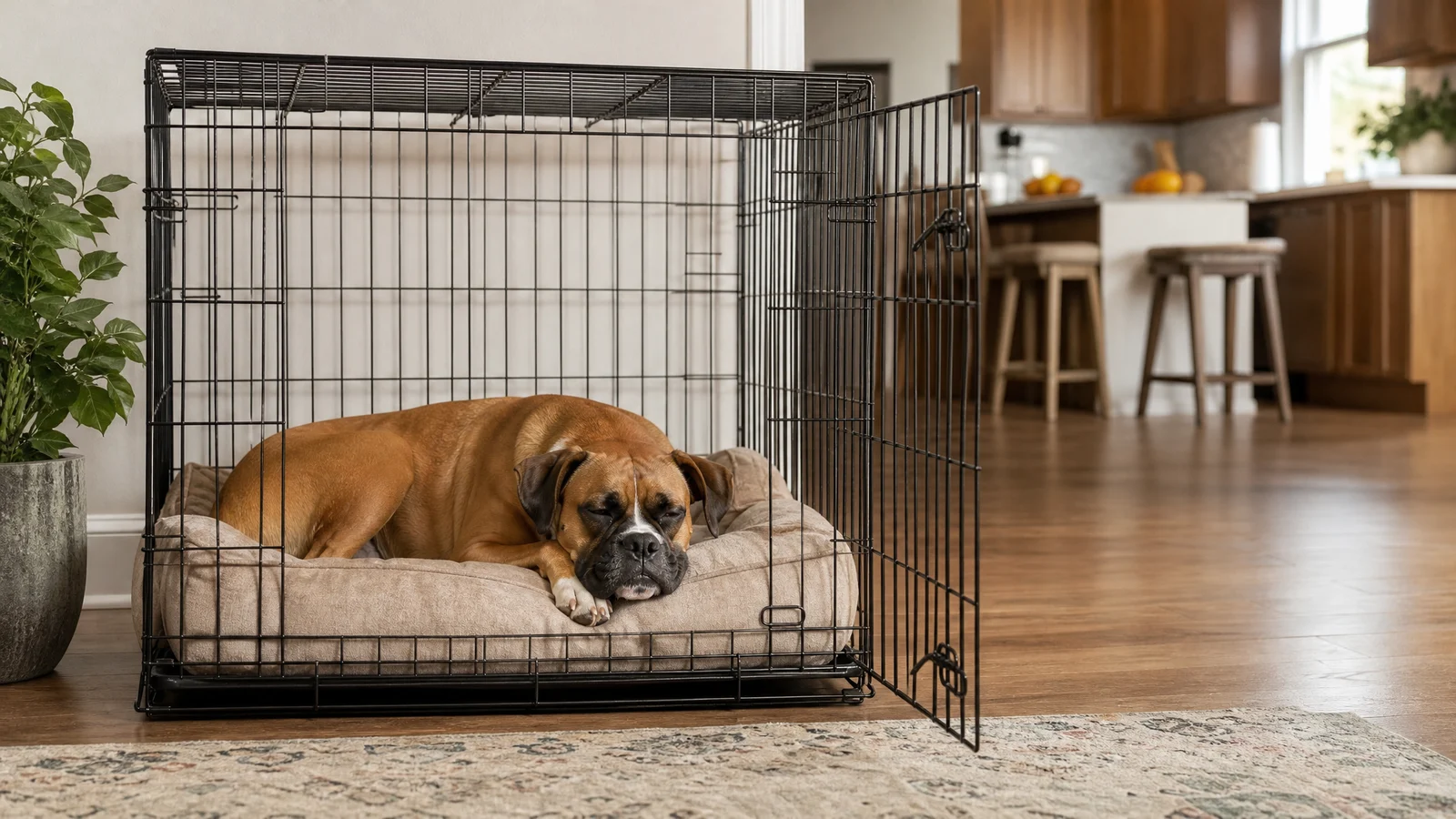
Crate training changes when the dog is a Boxer. Loyal affection can make distance from the family feel like a major event, while high energy and a busy mind make forced stillness a poor starting lesson. The crate must first become a comfortable place to rest. Alone time is a second skill, taught on its own careful track.
We will make each choice in the order it arises: where to put the crate, how to build voluntary entry, when to move the door, how to distinguish unfinished training from separation distress and how to extend absence without outrunning the dog. This guide does not use the crate as a test of endurance. It builds a flexible resting place and a Boxer who can remain calm when family movement changes.
The Boxer's Resting Setup
Location decides how difficult the first lesson will be. Put the crate where ordinary family life is visible but not constantly rushing past. A Boxer who values closeness can observe without standing in the center of every movement. Avoid beginning in an isolated space and expecting the dog to feel safe there simply because bedding is soft.
The crate should allow comfortable standing, turning and resting. Keep the interior simple and secure. Choose bedding only if the dog rests on it safely, and offer an appropriate chew or food activity while you are present to observe. The setup should feel predictable, not crowded with objects that turn rest into frantic play.
Meet physical and mental needs before practice, but do not exhaust the dog. A sniffing walk, an easy search game or a short training session can take the edge off a Boxer's energy. Our complete Boxer training plan explains how body and brain work fit together. Then allow a calm transition before approaching the crate.
Decide this first: if the Boxer can relax near the open crate, continue with entry training. If they avoid the whole area, improve the location and work beside it before asking for a step inside. The dog should not have to overcome the room and the crate at the same time.
Voluntary Boxer Crate Training
Begin with the door secured open. Let the Boxer investigate without being followed into the opening by your hands. Reward attention at the threshold, then place food at a shallow depth before gradually moving it toward the back as confidence grows. The crate introduction guidance from the RSPCA recommends moving at the dog's pace in brief sessions.
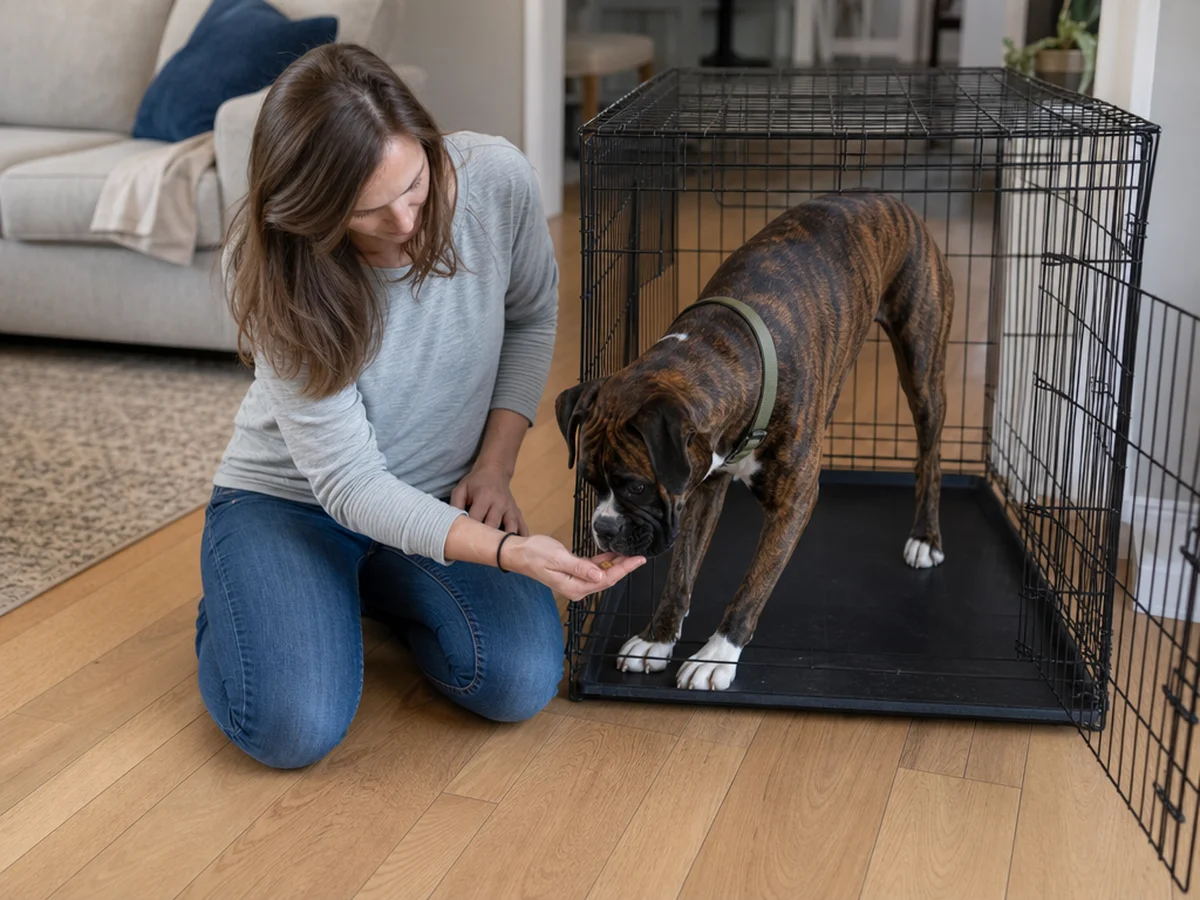
Mark each useful choice. Looking into the crate can earn a reward, followed by one paw, two paws and the whole body. A Boxer who enjoys solving problems may begin offering entry quickly. Do not mistake quick understanding for readiness to be shut in. Voluntary entry is the first decision point, not the completed lesson.
- Reward attention toward the open crate while the dog remains free to move away.
- Place food where the Boxer can reach it without stretching into a worried posture.
- Move the reward deeper only after the previous position looks easy and loose.
- Feed a calm activity inside with the door open, then release the dog before they rush out.
- Add a crate cue only when the Boxer is already entering willingly and can connect the word to the action.
Serve an occasional meal in the open crate if eating remains relaxed. Food puzzles can provide mental work, but the food should support calm rather than become bait that traps the dog. If the Boxer darts out as soon as the last bite disappears, shorten the activity and reward a brief pause before release.
Decision two is visible: continue when the dog chooses entry, eats normally and can turn or lie down without watching the exit constantly. Stay at the open-door stage when the dog stretches in, grabs food and retreats. Confidence is the criterion.
Crate Training With the Door
The door introduces sound, movement and restriction at once, so separate those pieces. Touch the door and reward calm. Move it slightly and reward again. Bring it nearly closed, reopen it and release the dog before concern appears. The lesson is that door movement predicts good things and always remains manageable.
Door Movement Comes First
Once the Boxer remains loose while the door moves, close it briefly while staying beside the crate. Deliver a reward through the opening, then open the door before the dog asks. Repeat with varied, short closures rather than a steadily lengthening endurance test.
If barking or pawing begins, wait for the smallest pause you can reward and reopen calmly. On the next repetition, make the closure easier. The goal is not to prove that noise fails. It is to prevent the dog from needing noise to communicate that the step was too large.
Distance Comes Later
Move your body only after a closed door is uneventful. Shift in the chair, stand up, sit down and take one ordinary step before returning. Mix easy repetitions with slightly harder ones. A Boxer watches family movement closely, so walking away can be a separate trigger even when the crate itself is comfortable.
Add household sounds and routines gradually. Pick up an object, walk across the room or open an interior door, then return while the dog is calm. Do not stack every departure cue at once. Our Boxer trainability FAQ explains why changing one variable keeps the lesson readable.
Crate Comfort Versus Separation Distress
A dog who dislikes a new crate and a dog who panics when alone may look similar for a moment, but the training decisions differ. Crate reluctance centers on the space or door. Separation distress follows the person's departure and may continue regardless of the resting area. Treating both as a need for more confinement can worsen the wrong problem.
Use the pattern across settings rather than one noisy episode. The comparison below shows which question to ask next and which part of the plan should remain easy.
| What you observe | Likely training question | Next choice |
|---|---|---|
| Relaxed near family, worried when the crate door moves | Is the door step too large? | Return to open entry and smaller door movements |
| Calm in the crate while you stay, distressed as you leave | Is absence the trigger? | Separate alone-time practice from crate practice |
| Distressed when left in different safe spaces | Is this broader separation distress? | Arrange support and seek qualified guidance |
| Sudden new distress in a familiar routine | Could comfort or health have changed? | Arrange a veterinary examination |
The ASPCA describes separation anxiety as distress rather than poor manners and advises keeping practice shorter than the point where the dog becomes upset. The same separation guidance notes that a crate helps only when the individual dog experiences the space as safe.
Do not use a crate as a stand-alone answer to separation anxiety. Crate guidance from PDSA recommends professional support when separation anxiety is involved. Arrange company or another safe plan while a behavior plan is being developed, so unavoidable long absences do not repeatedly overwhelm the dog.
Boxer Crate Training During Absence
Alone-time training begins below the dog's worry point. Start with a movement that predicts mild distance, such as stepping through an interior doorway and returning. The Boxer should remain able to eat, rest or notice you without escalating. Return while the behavior is still calm, then vary the next repetition.
Read Early Stress Signals
Watch for a fixed stare, sudden panting, refusal of food, rapid position changes, repeated vocalizing or frantic contact with the exit. One sign can have several causes, but a cluster that appears as you leave is useful information. Make the next absence shorter and easier.
Video from a safe household camera can show what happens after you step out, but it does not replace professional evaluation. Use it to identify the first change, not to wait through escalating distress. A successful absence ends with the dog still within their coping range.
Change One Departure Cue
Boxers notice routines. Shoes, keys, a bag and a closing door can become one large signal. Practice harmless versions separately. Pick up the keys and sit down, put on shoes before making breakfast or open the door and remain inside. Reward calm observation without turning every cue into a food shower.
Increase real absence unevenly. Follow a slightly harder repetition with an easy one, and include days when no increase happens. Progress is the dog's calm response, not a steadily rising number. If distress appears, return to the last comfortable version and consult a qualified reward-based professional.
Keep regular veterinary visits and seek an exam for a sudden behavior change. Health and comfort can affect rest and tolerance for separation. Addressing those factors protects the training plan from asking the dog to work through a problem that learning cannot solve.
Crate Training for the Long View
Track which part of the routine is improving. Entry may become easy before door movement does, and door movement may become ordinary before departure cues do. That uneven progress identifies exactly where practice should remain simple. Combine stages only after each one works separately.
A useful crate remains one option, not the only place a Boxer can settle. Practice resting on a mat, behind a gate and in a quiet room as well. Flexible calm makes travel, visitors and household changes easier without making one enclosure carry every responsibility.
Continue to place pleasant, low-pressure experiences in the crate after the basic skill is learned. Leave the door open during ordinary family time, offer an occasional calm activity there and release the dog without fanfare. A Boxer who enters by choice has kept the meaning you worked to build.
Expect the plan to change with the dog. Energy, comfort and family routines shift, so the best setup later may not match the first one. Preserve the two separate skills throughout: the crate is safe, and temporary distance from family is manageable.
The long-term result is not a dog who can be confined for the longest stretch. It is a Boxer who can rest without panic, communicate when a step is too hard and return to the crate willingly. Keep choice, gradual practice and calm independence at the center, and the crate can remain useful without becoming a test.
 Exercise and jobsBoxer Exercise Needs and Brain Games for a High-Energy Dog
 Training basicsHow to Potty Train a Boxer Puppy
 Training basicsBoxer Dog Training Built Around a Smart, Easily Bored Dog
