 Boxer
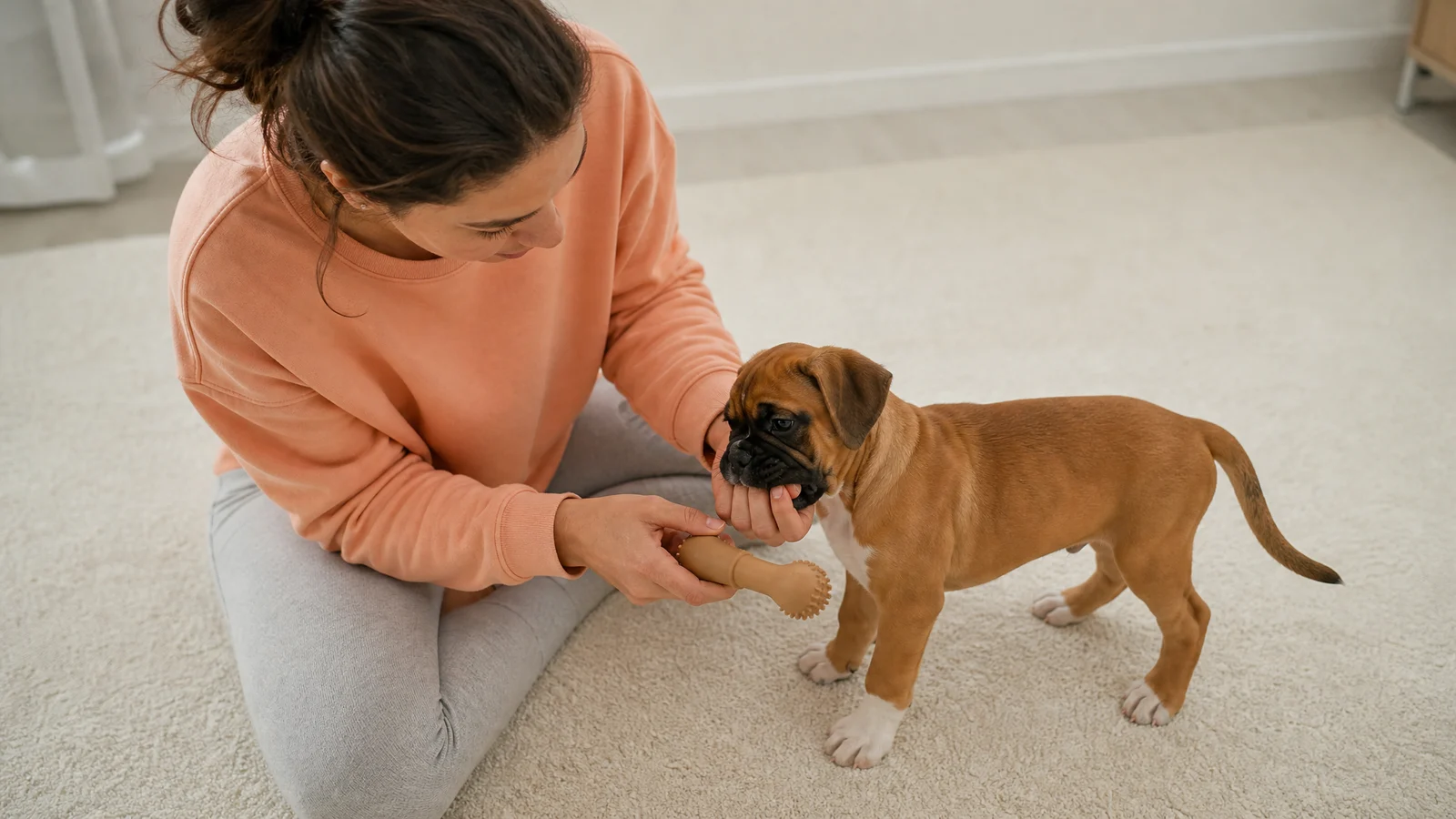
A Boxer puppy at three to four months does a lot of living with their mouth, and right now that mouth is louder in your day: more chewing, more grabbing, and teeth landing on hands and clothes whenever play gets exciting. Boxers are powerful, playful dogs who wind up fast, so it is hard to treat any of it as background noise.
The answer is two moves rather than a long list of rules: give sore gums better things to chew, and teach teeth to stop when they touch skin. The sections below cover why the mouth gets busier, how to stock the house, a trade routine for the things your puppy grabs anyway, what to do when play turns toothy, and the questions that tend to follow.
What Teething Does to a Boxer Puppy's Mouth
Both moves make more sense once you know what is going on in there. Puppies start growing their adult teeth when they are 12 to 16 weeks old, and their gums may be a bit sore while it happens, so biting tends to peak at about 13 weeks. All adult teeth are typically present by the age of 7 months.
For a Boxer, that sore, busy mouth meets a body built on power and play. Active, playful dogs rarely wait for a calm moment, and a puppy who is already wound up will happily use the nearest hand as the toy. That is why we treat chewing and grabbing as two separate jobs: gums need something good to work on, and teeth need to learn that skin is not an option.
Expect this to take months rather than days, and keep your regular vet visits on the calendar so someone checks those teeth as they come in. If a tooth looks odd to you or your puppy seems to be in real discomfort, that is a vet question too. For what else changes as your puppy grows, see our puppy training timeline.
Chews That Give Sore Mouths a Job
Sore gums are the reason the first move is about supply, because a puppy with good things to chew has less reason to go shopping on your hands. A strong supply for this age is a spread of options rather than one favorite:
- Soft rubber chews give a puppy something with a little give to work on while adult teeth come in, and a rope or plush toy adds a second texture to switch to.
- A rotating pile. It keeps things fresh, which matters for a Boxer who gets bored with repetition: leave a few toys out, put the rest away, and swap them every few days.
- One busy-hour chew comes out only when the household is at its most hectic, such as dinner prep, so it stays more interesting than your ankles.
- Clear Floors: They make the right choice the easy one, so shoes, cords and remote controls move up out of reach while the teeth are changing.
None of that works if your puppy can wander off with the wrong thing and nobody notices. A chewing puppy needs to be supervised at all times to be rewarded for choosing their own toys, and whenever you cannot watch, access to anything chewable other than the toys should be prevented. A gate, a playpen or a closed door does that job, and the chew pile waits for you inside it. If your puppy has already found the furniture, our Boxer chewing guide has the longer plan.
Trading Up When Puppy Teeth Grab the Wrong Thing
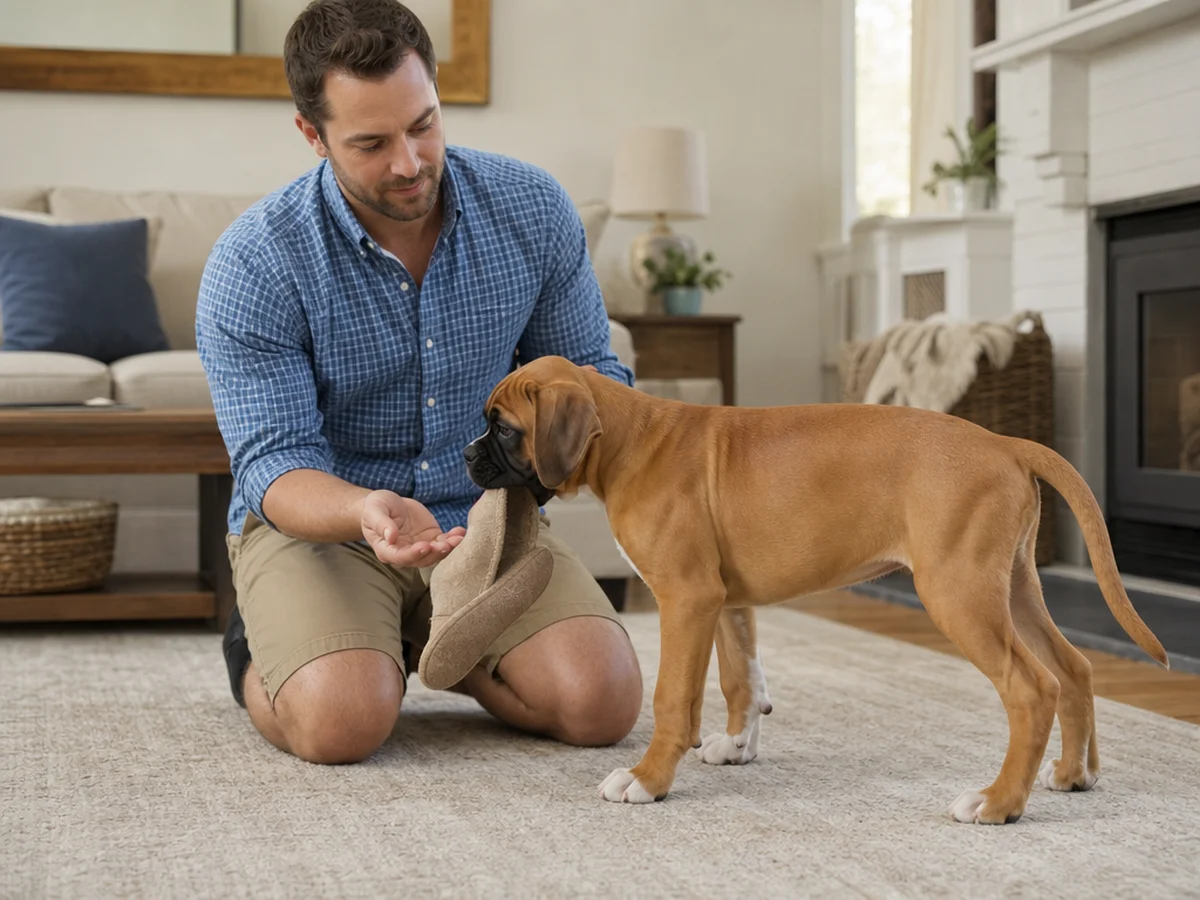
Supply and supervision shrink the problem, but a Boxer is an excellent problem solver, and a puppy who carries off a sock is often hoping you will chase. As Boxer people, we would rather turn that moment into a swap than a race, because a trade teaches the puppy that handing something over is how good things happen. Build it in four stages, and do the first two when nothing is at stake:
- Start With a Toy They Like: While your puppy chews it, bring a tasty treat to their nose, and the moment they let go, say yes and give the treat.
- Give the toy back right away, because handing it straight back shows that letting go costs nothing, and the swap becomes a game your puppy wants to repeat.
- Add the word. Once the toy drops every time the treat appears, say your word (trade works fine) just before you offer the treat, so the word starts to predict the swap.
- Try something dull: move to a low-stakes item like a plain cardboard tube before a shoe or a sock, and raise the treat's value as the item gets more interesting.
If your puppy ignores the treat or tightens their jaw, the swap is not worth enough yet. Go back a stage, pick a less exciting item or a better treat, and never pry the item loose, which only turns the trade into tug of war. Keep early practice short and cheerful, because a clever Boxer tires of drills quickly, and stop while your puppy is still keen.
Ending Play When a Boxer Puppy's Mouth Meets Skin
A trade handles objects, but the hardest grabs are the ones that land on you. Tug needs an off-switch, so teach the cues for tug and for trade or drop before you play, then, if your puppy's mouth touches your skin at any point, calmly end the game and remove yourself for a brief break, as Wisconsin Humane Society's mouthiness guide lays out. A break of about 30 seconds is the starting point there, and you return once the puppy has calmed down.
With a puppy who is mid-game and not in a listening mood, that looks like this. Stand up, go quiet and walk away without a fuss, because a big reaction is more fun than the game was. Step behind a gate or into another room, wait out the break, then come back with a toy already in your hand so the first thing your puppy meets is something legal to grab. Pay for the quiet moment that follows, whether that is a calm sit or a chew on the toy.
What you should see over the following weeks is a puppy who settles faster after each break. If the grabbing keeps escalating, the game was too wild to start with, so end it earlier next time.
We see the same pattern late in the day: a tired puppy grabs more, so a nap counts as part of the plan. Our Boxer soft-mouth guide covers the longer bite-inhibition plan.
Smaller Questions About a Busy Mouth
Three situations change how the routines above play out: who else is in the room, what kind of play you enjoy, and how long you can expect all this to last. Each gets a short answer here.
Can we still wrestle with our Boxer puppy?
Wrestling is risky at this age because wiggling fingers and flailing hands look exactly like toys. Swap it for fetch or a tug game with the cues you taught, which keeps the fun and gives the mouth a target. A Boxer's love of rough play does not have to disappear; it just moves onto a toy.
What if children are the ones getting grabbed?
Keep an adult in the room for every meeting, and teach children to end the game by calmly leaving the area rather than squealing or running, since movement is exciting. The adult can then offer the puppy a toy from their own side. Our kids and dogs guide covers introductions in more detail.
When does this mouthy phase end?
The teething part ends when the adult teeth are in, and the habit part ends when grabbing stops paying off. That second clock is the one you control: every trade, every calm return and every toy-first greeting shortens it.
Bringing a Toy to Start the Game
Some of those grabs are your puppy's way of starting play, which turns this whole page into one lesson: teaching the polite way to ask. A puppy who has been traded with, paused with and paid for calm learns that teeth on skin ends the game, while a toy in the mouth keeps it going.
When your Boxer trots over carrying a toy instead of lunging at your hand, make a fuss of them, because that is the moment everything above has been building, and it is worth paying for every single time.
Teeth and toys are only the opening stretch of raising a Boxer, and our e-book, which reaches you by email when you register on this site, covers every need your puppy will have as they grow, with depth where it counts and clear wording throughout.
 Puppy trainingBoxer Puppy at 4 to 6 Months: What Changes
 Puppy trainingBoxer at 6 to 12 Months: Adolescence Begins
 BehaviorBoxer at 1 Year and Up: When Do They Calm Down?
