 Boxer
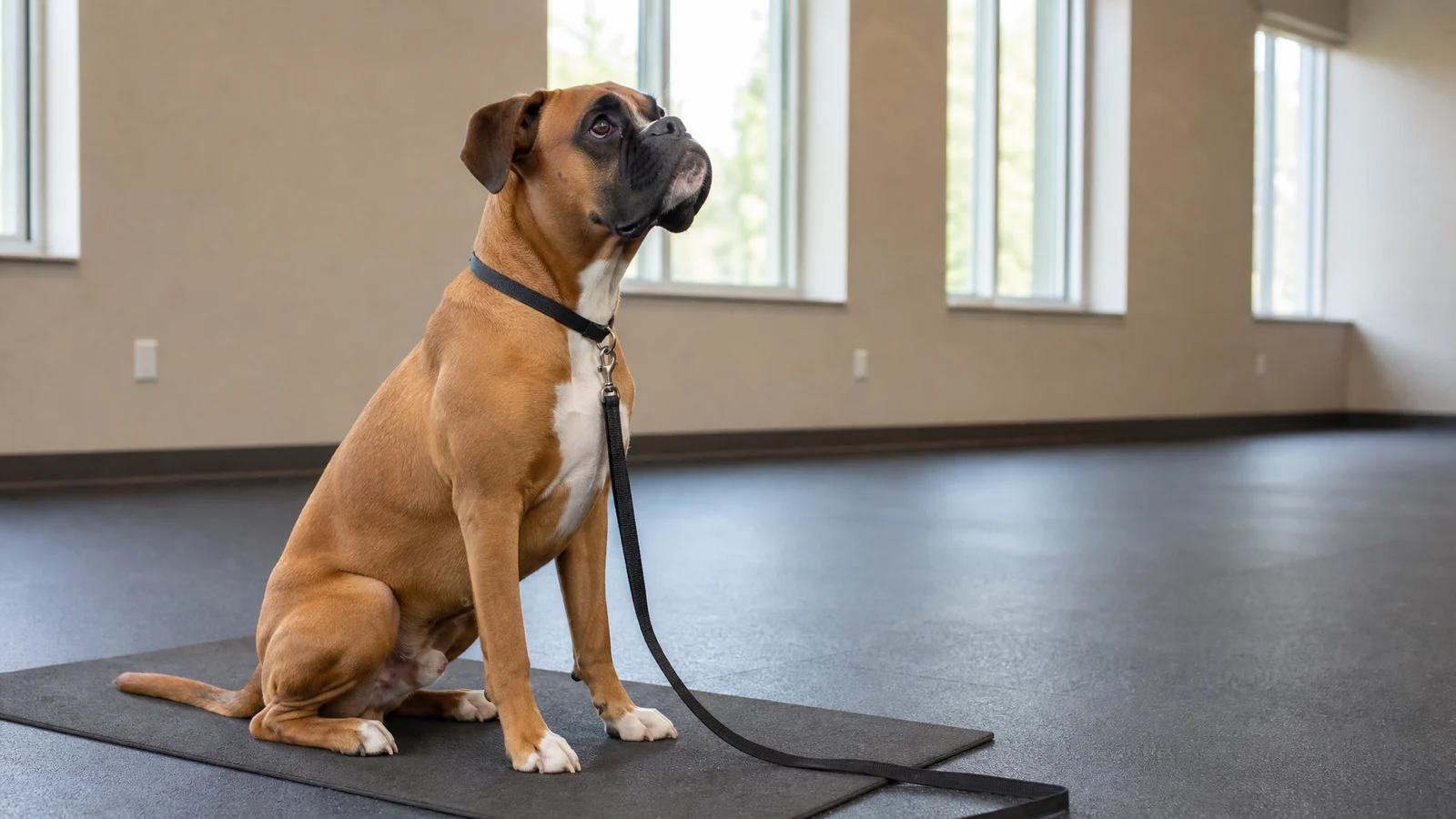
A Boxer's first hello is rarely subtle. How a trainer handles it will tell you more about their methods than any website can.
Hiring help for a strong, quick-witted dog gets easier once you know what to look for, because the title on a business card says very little. Anyone can use it, the quality of teaching varies widely, and a mismatch costs you weeks of lessons that never fit the dog standing in front of you, along with the patience you had left for training at all.
You do not have to become a training expert to hire well. A handful of checks, covered below, will show you whether a trainer's lessons are built for a dog who bounces, bores easily and loves to work things out.
How Bounce and Boredom Shape the Trainer Search
That first hello is also a preview of every lesson. A Boxer is powerful, active and playful, and young Boxers spend a good deal of time jumping and leaping about, so any trainer you hire will be teaching manners to a dog who greets the world with their whole body.
Boredom is the other half of the picture. Boxers are highly intelligent, but they can become bored with repetition, and they tend to have a mind of their own. That makes them excellent problem solvers and poor candidates for endless drills, so a trainer who repeats one exercise until the dog drifts off has a planning problem, not a dog problem.
Those traits give you four tests to apply to every trainer on your list. Each one is easy to check on a call or during a trial lesson.
- Handling the bounce: The trainer stays relaxed when your Boxer jumps or leaps, rewards four paws on the floor and shows you how to do the same instead of treating the energy as bad behavior.
- Variety without chaos. Exercises, rewards and games change often enough that a bright dog never has time to get bored, yet every change still builds toward one clear goal.
- Size and strength are part of the plan, so a good trainer explains how a powerful dog will be kept safe and manageable on a leash without pain or force.
- Fit With Other Dogs: Boxers are not always tolerant of other dogs of the same sex, so a group class has to leave your dog room to step away and relax.
A trainer who handles all four well will usually handle everything else on this page too. Keep them in mind as you read on.
Who Can Call Themselves a Trainer
Those four tests only help if you can tell who is qualified to run them, and the word trainer is little help there. Dog training has no licensing requirements or regulatory oversight, which makes it hard to know what to look for. Certification fills part of that gap, and the main trainer credential from the Certification Council for Professional Dog Trainers means the person passed a comprehensive exam and has at least 300 hours of dog training experience.
Checking a Credential Yourself
A credential only helps if it is real, so ask for the exact name of what the trainer holds and look it up with the group that issued it. Then ask what the exam or assessment covered and whether it included teaching skills, because passing a test and coaching a bouncy dog and a distracted owner are different jobs. A good trainer will answer without any fuss and may be glad you asked.
Treat a vague answer as an answer. If the trainer cannot name the credential or the group behind it, you have learned something before you spent a dollar.
What Titles and Letters Leave Out
Even a solid credential says little about the dog on your leash. Words such as consultant, specialist and behavior expert can appear on any business card, so judge the person by what they can explain and demonstrate. Ask how much of their teaching has been with large, excitable dogs, which problems they work on most, and which ones they send to someone else.
Experience with your kind of problem counts at least as much as experience in general. A good trainer is comfortable saying where their skills end, and will name someone else when your dog's needs go beyond them.
Reward-Based Training That Keeps a Boxer's Mind Moving
Credentials only open the door, and what happens in the lesson is what your Boxer lives with. The American Veterinary Society of Animal Behavior takes a clear position on humane training: a good trainer should avoid any tool or technique involving pain, intimidation or physical force, and that clients should steer clear of anyone who talks about "leader of the pack" or "alpha" theories.
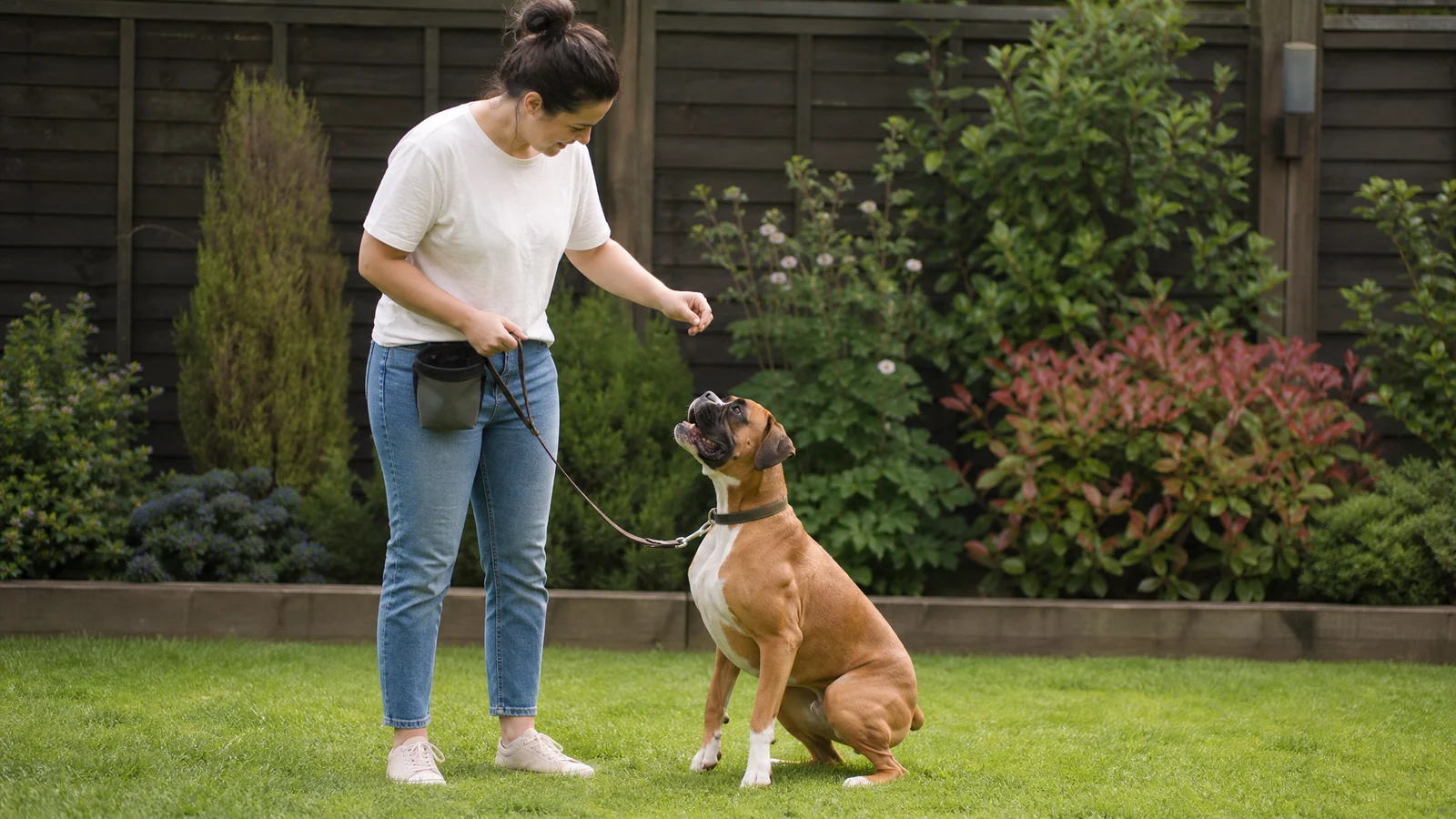
In practice, reward-based teaching sounds simple. The trainer asks with a cue, marks the instant the dog gets it right with a click or a word, and pays with food, toys or play, so your Boxer learns that working things out is worth the effort. Ask the trainer to walk you through a typical lesson, and listen for this order:
- Start with a win. The first exercise is one your Boxer can get right, and the reward arrives within a moment of the correct behavior.
- Raise the difficulty in small steps: Each exercise gets a little harder only after the last one is going smoothly, so your dog is rarely left guessing.
- Change the game before attention fades, rotating exercises, rewards and short play breaks often enough to keep a quick mind interested.
- Let the Dog Take a Break: A turned head or a long sniff tells the trainer the session needs adjusting, and a good trainer lowers the difficulty or finishes on an easy success instead of pushing on.
A plan that looks nothing like this, or a trainer who cannot describe one at all, is not a fit however polished the website looks. If you want the bigger picture of how we approach training a Boxer from the first day, our complete Boxer training guide lays it out.
A Training Setting That Fits Your Boxer's Social Side
A sound method still has to be delivered in the right room, and for a Boxer the social setting matters a great deal. The ASPCA's guidance on professional behavioral help draws a useful line: group classes for basic manners such as sit, down and coming when called, and private sessions when a dog has a specific problem that needs a plan built around it.
Groups suit most Boxer puppies and plenty of adults. Early socialization and puppy classes are vital for channeling a Boxer's energy and exuberance in a positive way, and our guide to puppy socialization classes covers that stage in more detail.
Whatever the age, ask how a class matches its dogs, because Boxers are not always tolerant of other dogs of the same sex. A good instructor keeps groups small enough to manage, leaves room for your dog to step away from a dog they dislike, and steps in early rather than waiting for trouble. If the room feels like a free-for-all, your dog will practice getting wound up instead of practicing manners.
Private lessons suit a Boxer who gets overexcited in company, a household with one specific problem, or an owner who needs coaching on timing. Home visits add a bonus: the trainer sees the door, the stairs and the couch where the real jumping happens, and your dog practices where it counts.
Board and Train Deserves Extra Questions
With board and train you are not there to see how your dog is taught, so ask for the exact methods in writing and whether you can watch a session. Expect a hand-over lesson too, in which the trainer shows you everything your Boxer learned, because your Boxer has to practice every skill with you, not just with the trainer.
Trying a Trainer Out With Your Dog in the Room
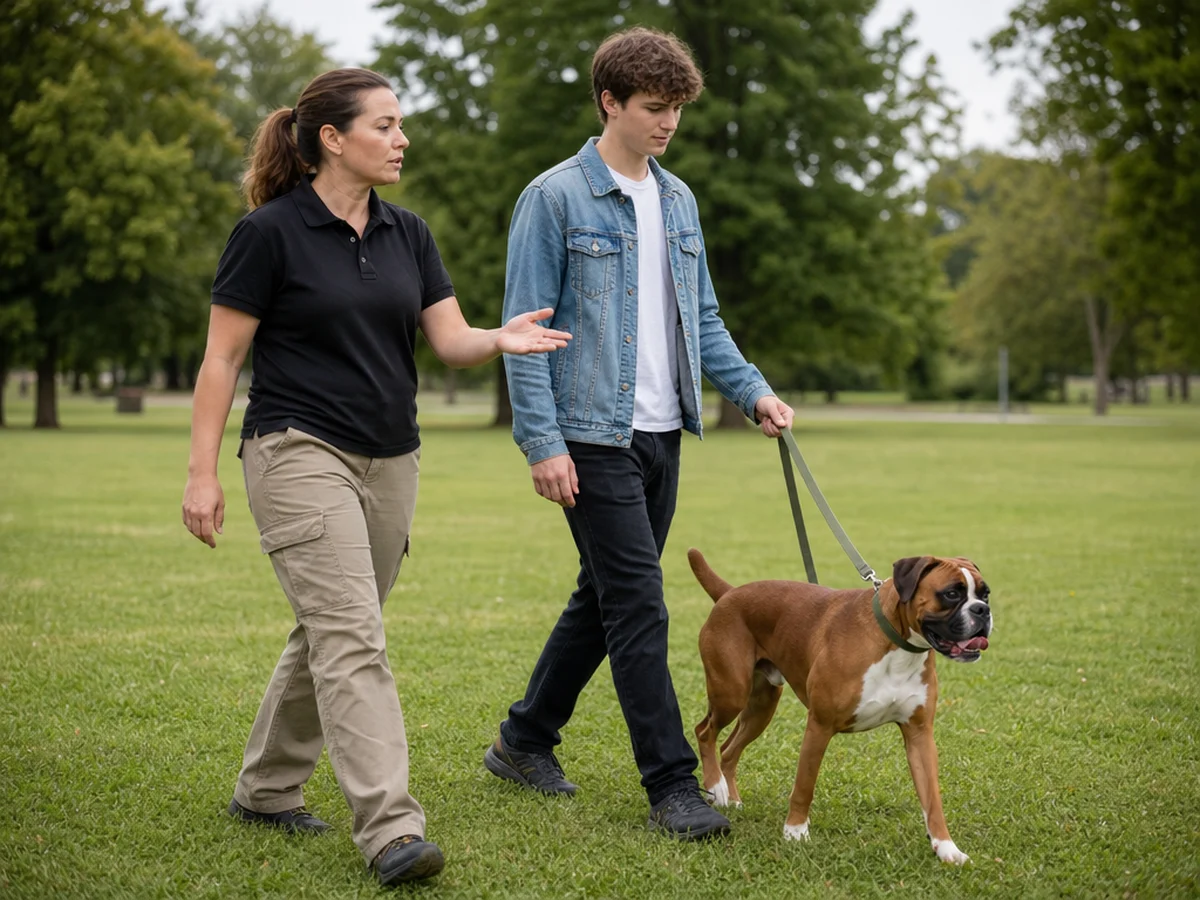
A trainer who passes on paper still has to pass in person, and you can test that before paying for a full package. Think of it as two short steps, one without the dog and one with, so your Boxer only spends time on candidates who survived the first.
The First Call
Ask the trainer to describe a typical first lesson with a bouncy, easily bored dog, then listen for specifics: which rewards they use, what they do when a dog gets overexcited, and what happens if your dog finds the session too much. Ask whether you can watch a class or lesson before committing, and whether they can give you a couple of references from past clients or a veterinarian. Contact more than one trainer so you have something to compare.
Ask the practical questions as well: what a package includes, how missed sessions and cancellations are handled, and whether you can stop after the first lesson if it is not working. A trainer who is confident in their teaching rarely minds that last question.
Pay attention to how the answers feel as well as what they say. In our experience, a trainer who welcomes questions and explains things plainly to you is usually the one who explains things plainly to your dog.
The Trial Lesson
Bring your Boxer, plenty of small treats and a toy, and let the first session be an audition. Watch how the trainer greets the dog: calm, friendly and unhurried is the right start, and a trainer who braces against the bounce or raises their voice to be heard has shown you what the next hour will feel like. Look for quick, clear rewards, a pace that shifts before your dog gets bored, and room for your dog to look away or take a breather.
Then check yourself. By the end you should understand each step well enough to repeat it at home, and the trainer should be able to tell you what to practice before the next lesson and why. If you leave confused, or if your dog leaves frantic, take that seriously and keep looking, however strong the credentials were. Watch for the stalled moment too: when something is not working, a good trainer changes the approach instead of repeating the same request louder.
When a Vet or Behaviorist Comes Before Any Trainer
A trial lesson sometimes shows that a trainer is the wrong kind of help, or that the problem is bigger than a lesson can fix. Spotting those cases early matters, because the wrong first call costs weeks and can leave a real issue untouched.
A behavior problem may have a physical cause, so a sudden change in your Boxer's behavior starts with your veterinarian, not a training class. If the problem is aggression toward people or other animals, the American College of Veterinary Behaviorists recommends getting professional help from a veterinary behaviorist, because the consequences and liability are so serious. That is a decision to make quickly.
Your Boxer should see the veterinarian for regular checkups anyway, and those visits are a good moment to mention anything that has changed, from how your dog moves to how they react to visitors. If handling at the clinic is hard, our guide to vet handling practice shows how to build it at home.
A good trainer will tell you when they are not the right person and will send you back to the vet or on to a specialist without making you feel foolish. Once a physical cause has been ruled out and the problem is a skill or a habit, a trainer is the right call, and the checks above will serve you well.
The Trainer Who Helps You Read Your Boxer
Every check above comes down to one question: after the lesson, do you understand your dog better than before? Every lesson with a Boxer is a chance to learn what makes this dog tick, whether that is what holds their interest, what tips them over the edge or what they work out on their own. A certificate cannot give you that, and it is the clearest sign you have found the right person: you leave able to say why your Boxer did what they did, and what to try next.
Between lessons, your Boxer's training carries on in the kitchen, at the front door and on every walk, and our e-book covers those everyday moments along with every other skill a Boxer needs, thoroughly and in words you can follow while the dog is bouncing. Readers receive it without charge after filling in the registration form on this page.
 Training basicsAre Boxers Easy to Train? Temperament and Trainability FAQ
 Exercise and jobsBoxer Sports and Jobs: Putting the Breed's Instincts to Work
 Training basicsCrate Training a Boxer and Preventing Separation Anxiety
