 Boxer
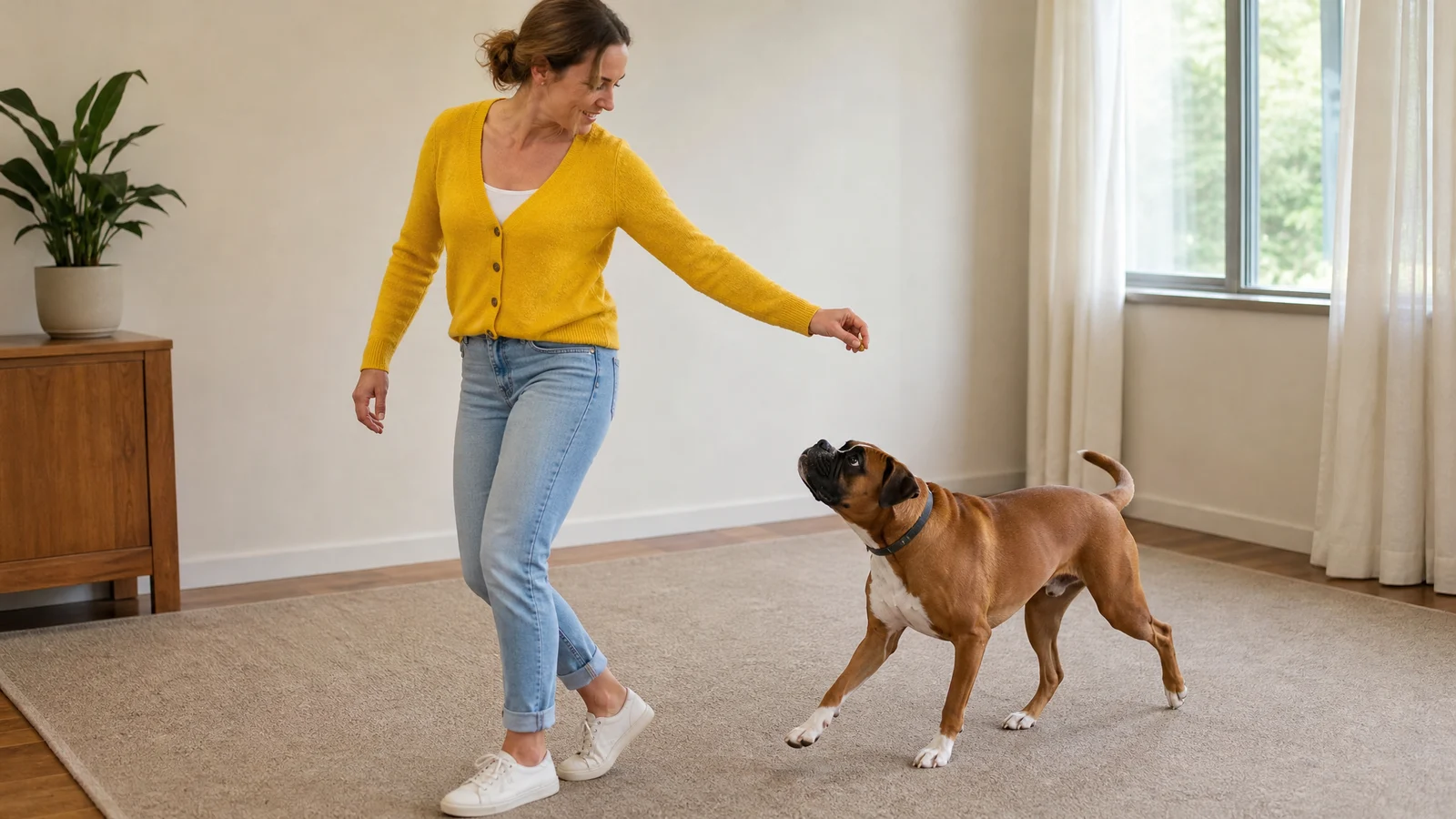
Hold a treat in front of an excited Boxer and you may get a leap instead of a turn, which is exactly why a spin is worth teaching. It trains the nose to travel with your hand rather than grab for it, and every turn ends with your dog facing you, ready for whatever comes next.
A good spin is slow, wide and built in small pieces. Your Boxer turns their head, then their shoulders, then the whole body, and each piece earns its own reward before the next one begins. That steady change suits a clever, easily bored mind far better than the same drill repeated over and over.
This guide covers the setup, each stage of the turn, the move from lure to spoken word, and fixes for the places where a lesson can wobble. Take the stages in order, and let your dog's ease with each one tell you when to move on.
Setting Up Your Boxer's Spin Trick
A spin begins before the first treat moves, because a slick floor or a cramped corner spoils more first lessons than any mistake in technique. Choose a spot with room for your whole Boxer to turn without brushing a table leg, and give their paws real grip: a rug over bare tile works far better than the tile alone. A quiet room helps too, since nothing else is competing with your hand.
Choosing a Direction and Treats
Decide which direction you will teach first and stay with it until the turn is smooth, because switching sides early leaves a dog with two half-learned patterns instead of one solid one. Keep a handful of small, soft treats that go down in a second, so the lesson never slows to a chew.
Checking Your Boxer First
Make sure your Boxer has no medical or joint issues which might be made worse by the spinning. If you have any doubt, ask your vet before the first lesson, and keep regular vet visits on the calendar either way. A smaller, gentler circle is a perfectly good version of the trick for a dog who needs it.
Luring the Spin One Piece at a Time
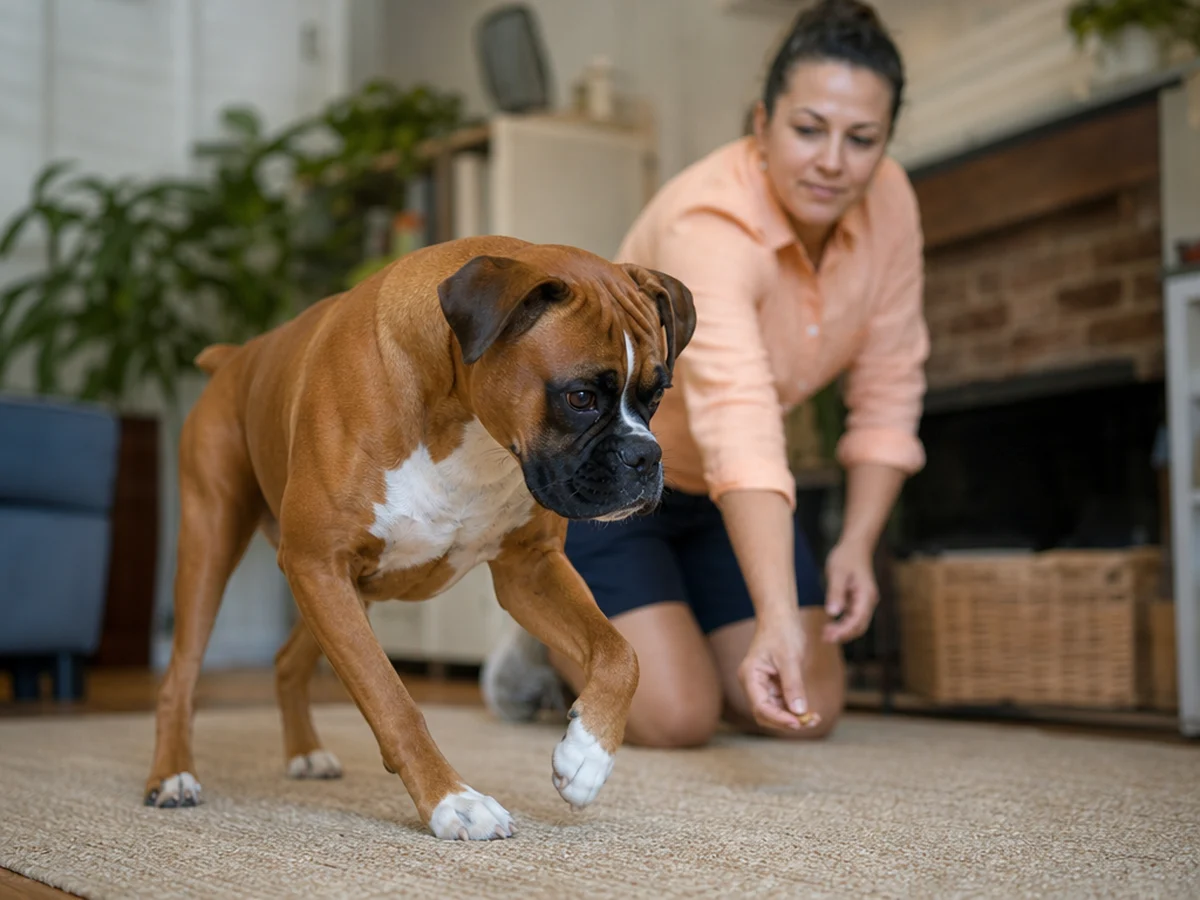
With the room and the treats ready, the trick itself is three pieces of one circle, and each piece gets paid before the next one starts. Keep your lure hand close to your dog's nose, low and slow, because height and speed are what turn a lesson into a leap. As Boxer people, we know a high lure is an open invitation to jump, while a hand at nose level only invites a nose.
Timing matters just as much as position. Mark the moment the movement finishes with a quick yes, then hand over the treat, because a reward should land within seconds of the behavior or a dog may not connect it with the right action. A treat that arrives after your Boxer has wandered off teaches them about wandering, not turning.
The First Quarter Turn
Start with the smallest piece. Show your Boxer the treat, let them sniff it, then slide your hand slowly from their nose toward one shoulder. The moment their head swings around and their front feet shuffle, say yes and pay.
Repeat until the head turn comes easily, then ask for a little more, with the shoulders following the nose through about a quarter of the circle. If your dog stops following, your hand has probably drifted away from their nose, so bring it back in close.
Half Circle and the Back End
The back half asks more of your dog, because the nose has already turned and the hind legs still have to follow it. Keep the treat moving past the shoulder and along the flank, and pay when your Boxer's hips swing round and they face away from where they began. If they stop, sit or back up as your hand moves on, you asked for too much at once, so pay the quarter turn a few times again before reaching for the longer arc.
Closing the Full Circle
Once the half circle feels easy, keep the treat moving until your Boxer has come all the way around and is facing you again, then mark and pay right at that finish. Make the first full circles wide and slow and leave speed alone, since a Boxer's natural energy will supply it later.
Repeat the full turn until your dog follows it without hesitation, and only then change anything else. If your Boxer wanders out of the circle halfway, keep your hand lower and closer and go back to the half circle for a few easy turns.
Adding a Spin Command Your Boxer Can Follow
A dog who circles smoothly after a lure has learned the movement but not yet the word, and the word comes last because everything that guides the movement has to be taken away first. The first helper to go is the treat in the hand that guides: trace the same circle with an empty hand, say yes when your Boxer finishes, and pay from your other hand so food is never what they are following.
Expect a brief pause when the treat disappears from your guiding hand. If your dog looks unsure, go back to the stage before and pay it a few times, then try the empty hand again.
From there the fade runs in four short steps, and each one should look easy before you try the next, so work through them in order and keep every circle small and calm:
- Trace the full circle with your empty hand, mark the finish and pay from the other hand.
- Shrink the movement into a small flick or a pointed finger, still marking and paying every completed turn.
- Say “spin” in a calm voice, pause for a moment, and only then show the small signal.
- Stretch that pause bit by bit until your Boxer starts turning on the word alone, then let the signal fade.
The word comes in only once the signal is small and reliable, because adding it sooner just gives your Boxer a sound to ignore while they watch your hand. If the turn falls apart when you add the word, go back to the signal alone for a few rounds.
Taking the Spin Beyond the Living Room
Once the word works at home, the next job is making it work almost anywhere, and that happens by changing one thing at a time. Indoors before outdoors is the usual order: begin in a spot without other people, animals or television noise, because you'll probably want to start inside and move outdoors once your Boxer has mastered the trick.
Each new room, then the yard, then a quiet street counts as a new place, so lean on the signal again whenever the surroundings get exciting. Change the place or the treat between lessons rather than drilling the same circle, because a Boxer is a smart, easily bored dog and a little variety keeps their attention on you.
The opposite direction deserves the same patience. Teach it from the beginning with a fresh lure, the same small pieces and the same wide, slow circle, because a turn that comes easily one way may not feel the same going the other.
When a Boxer's Spin Lesson Goes Off Track
Rough patches come with any trick, and three of them are common enough in a spin to be worth planning for. Each fix below changes what you ask for or where the treat sits, never how hard you push:
- Hopping for the treat: if your Boxer jumps instead of turning, your hand is too high or too far from their nose, so lower it, bring it close and pay only when all four paws stay on the floor. Our guide to four feet on the floor covers the habit in detail.
- Keep the circle slow. A lively dog can turn a circle into a gallop, so slow your hand to a crawl, wait for a calm turn and pay that one rather than the fastest.
- A bored Boxer will drift away from a lesson that repeats the same turn, so end sooner, switch treats or ask for something easy you already have before trying the spin again.
In each case you are changing the task, not pushing the dog, so the next attempt starts from something your Boxer already does well. Pay that easy success generously, and the lesson ends with your dog feeling clever.
One Spin Word, Two Directions
A Boxer who has only ever turned one way has learned a motion, and a motion is easy for a quick mind to run on autopilot. Asking for the opposite direction shows whether the word has taken hold or whether your dog has simply memorized a circle.
Boxers are excellent problem solvers, which cuts both ways. They work out a pattern fast, and they will start guessing it before you finish asking. Ask for one direction and then the other in no fixed order, paying every clean turn, and the word becomes something your Boxer listens for rather than something they expect.
Patient pieces, paid at the right moment, are how a spin gets built, and the same approach runs through our free e-book, which a short sign-up here puts in your inbox and which works through all the training a Boxer needs, deep enough to rely on yet gentle enough for a beginner.
 Exercise and jobsHow to Teach a Boxer to Roll Over
 Exercise and jobsHow to Teach a Boxer to Weave Through Your Legs
 Exercise and jobsHow to Teach a Boxer to Jump Over Obstacles
