 Boxer
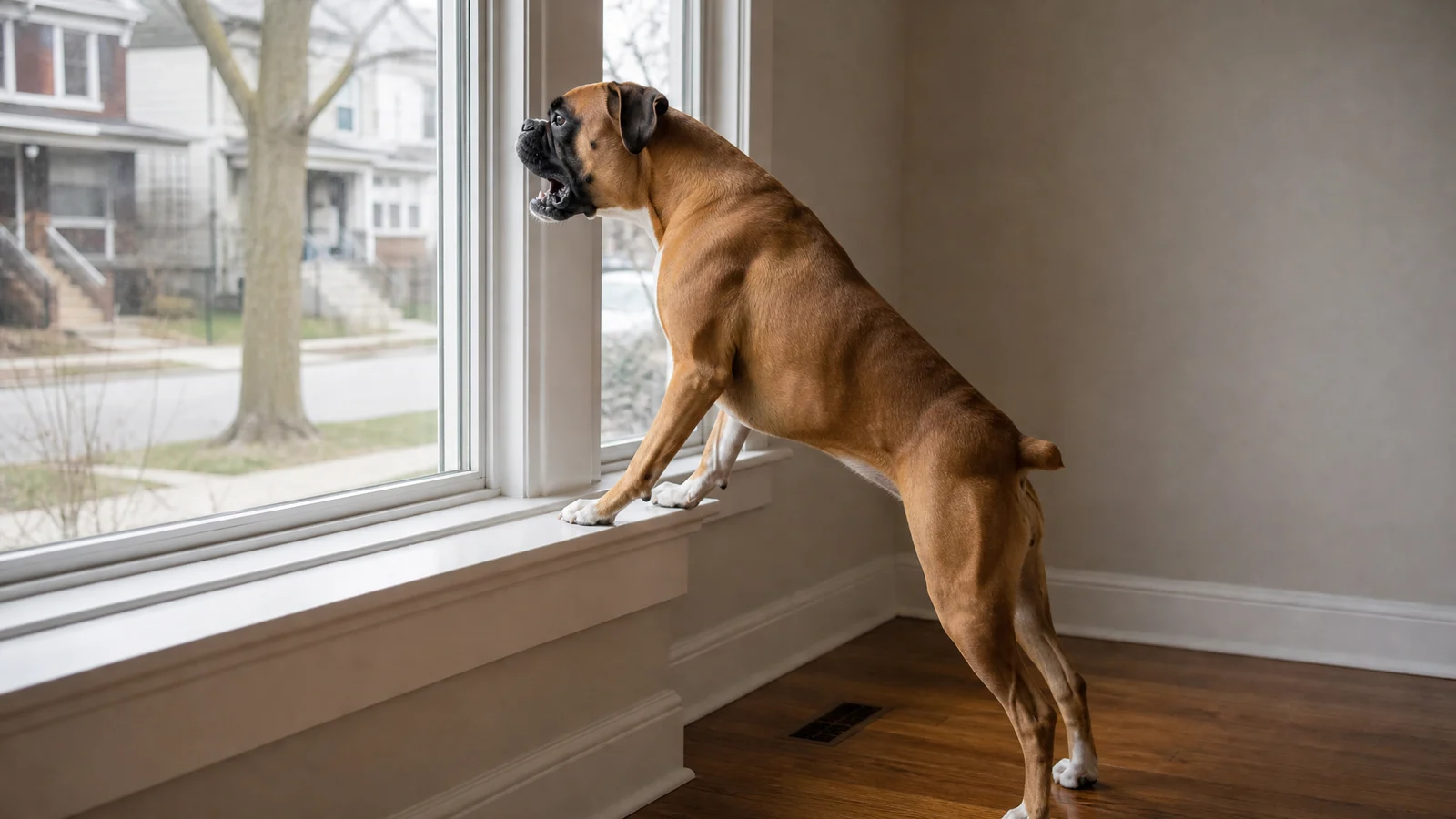
Most Boxer barking has a reason behind it, and that is both the good news and the catch. A reason can be changed, though it is rarely the one you would have guessed from the couch.
The usual suspects are a stranger on the sidewalk, the doorbell, a toy stuck under the sofa, and the long stretch of afternoon when nothing happens at all. Each one needs a different fix, which is why a single “Quiet!” shouted across the room tends to make things louder and the neighbors no happier. You do not need a silent dog. You need a Boxer who says their piece once and then lets it go.
Below, you'll find how to read the job behind each bark, how to take away the audience at windows and doors, and how to teach a quiet command that suits a clever, easily bored dog.
The Job Behind Every Boxer Bark
Before you change a bark, find out what it is for, because the answer decides the fix. The breed gives you a head start, since in the American Boxer Club's own portrait a Boxer is always vigilant but not a nervous breed, and will not bark without cause.
That matches what we see in living rooms. A playful, energetic, people-loving dog with a keen eye for anything new has plenty of reasons to speak up, so nearly every bark traces back to something your Boxer noticed, wanted or could not reach.
Three jobs cover most of the barking you will hear. Telling them apart takes a few days of watching the body behind the noise.
- The watchman bark comes with a stiff, forward-leaning body and shows up at windows, knocks and footsteps in the hall, and it keeps going until whoever caused it leaves.
- Greeting barks. The body is loose and wiggly, the tail is going, and the noise is aimed at a person or dog your Boxer is thrilled to see.
- The asker's bark: This one is aimed at you, with a toy, the leash or the back door as the subject, and it stops the moment you respond.
A Boxer can use all three in a single afternoon, and a visitor at the door can set off every one in a row. Start with the bark you hear most, and keep the odd one out for the section on getting help.
Taking Away the Audience for Window Barking
The watchman bark is the easiest one to improve, because you can change the audience before you change a single habit. Here is why that matters: your Boxer barks, the passerby keeps walking, and from the dog's side the job worked perfectly. That payoff repeats every day, and no quiet command can compete with a result like that.
So start by taking the view away. For barking at people or animals passing the living room window, the advice from Humane World for Animals is to manage the behavior by closing the curtains or putting your dog in another room. Frosted window film, a gate that keeps your Boxer off the sofa facing the street, or a shut door to the front room while you are out all do the same job.
Keep yard time supervised too, so your dog cannot rehearse fence barking when nobody is there to interrupt it. Resist the urge to join in. Saying “Who's there?” or hopping up to look out beside your dog tells a naturally vigilant Boxer that the watch matters. We are not trying to build a better watchman here, only a calmer one, and our look at Boxers as guard dogs covers the instinct behind it.
Boxer Barking Solutions for Doorbells and Visitors
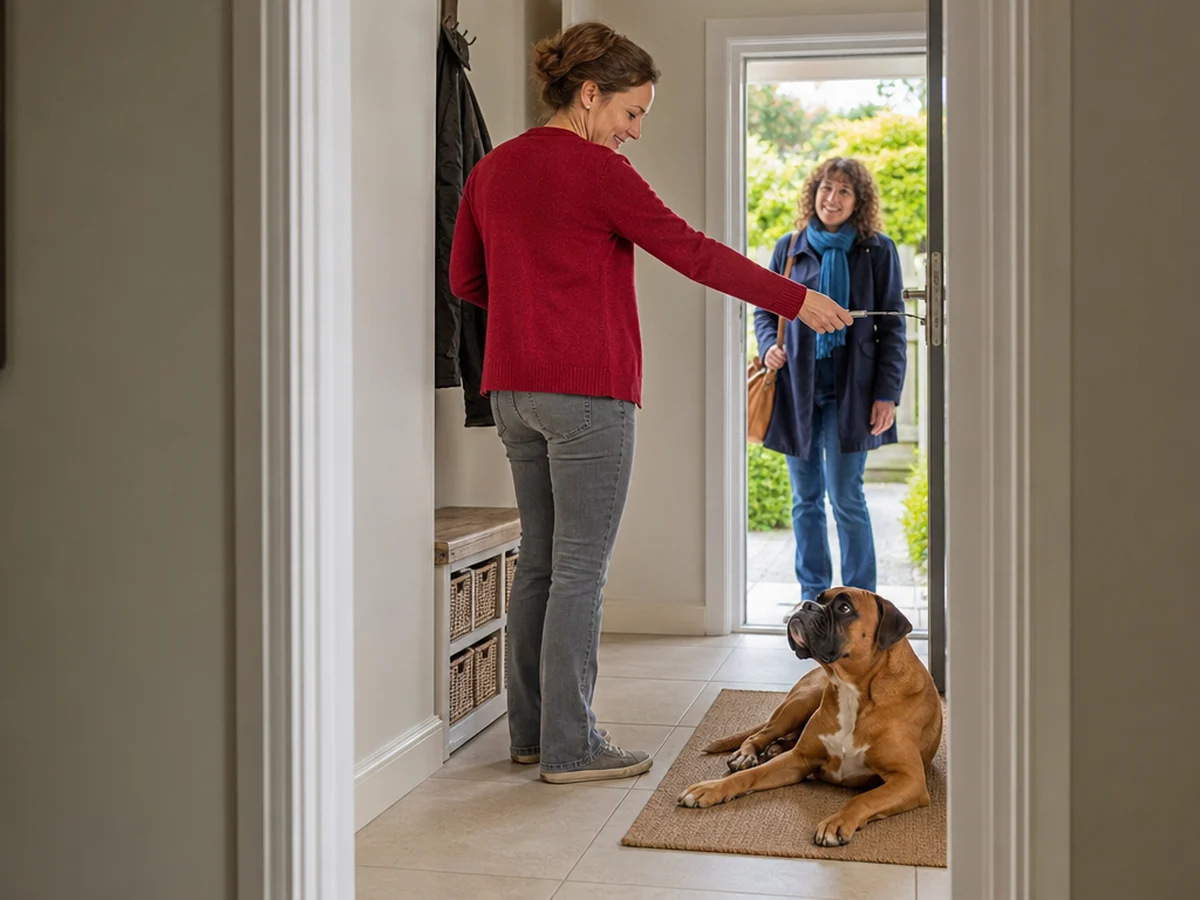
The doorbell is where a Boxer's watchfulness and their love of company collide, so the fix gives them a job to do instead of a barking contest. Teach it in two parts, the place first and the noise second, because a dog who is already wound up by a real knock cannot learn anything new.
Building the Place Routine
Pick a mat or bed a few strides from the door but still in sight, and practice while nobody is coming, so the routine is a game your Boxer already knows before the excitement arrives. Three steps build it.
- Say “Place,” toss a treat onto the mat and let your Boxer go and get it, so the mat becomes the spot where good things land.
- When they walk onto the mat on their own, ask for a sit or a down, pay for staying there, then release them with a clear word such as “Okay.”
- Send them from different spots in the room, so the word means “go to the mat” from anywhere and not just from beside the sofa.
Move on from each step only when your Boxer does it smoothly several times in a row, and skipping ahead is the usual reason the routine collapses at the first real knock. If the sit or down is shaky, firm it up with our guide to sit, down and stay before you add any noise.
Adding Knocks, Bells and Real Guests
Once the place routine is solid, add the sounds in their mildest form, such as a soft knock from a helper outside while your Boxer is on the mat, and pay for staying put. Then open the door a crack. If your dog gets up, close it right away, because the door only opens while they stay on the mat. Ask visitors to sit down before your dog is released to say hello, so the greeting happens after the barking would have.
Build up to a ring of the bell, then a helper stepping inside, and finally a real guest with a leash clipped to your Boxer so you can guide them to the mat without a scramble. In our experience the real doorbell is harder than any practice one, because the stakes feel higher to the dog.
If barking breaks out, you have moved up too fast. Drop back to the last level where your Boxer stayed quiet and rebuild from there.
Teaching Boxers a Quiet Command
Management lowers how often the barking starts, and a quiet command shortens how long it lasts, so now your Boxer needs to learn what that word means. A clever Boxer gets bored with drills, so keep each session to a handful of tries and change the setting or the treat now and then. Shouting “Quiet” over the barking works against you, because your dog hears more noise rather than a request. Teach the word in a calm voice, and teach it in the gap between barks.
Catching and Paying the Pause
Barking has natural breaths, and the first one you catch is your teaching moment. These three steps teach the word.
- Let your Boxer bark a couple of times at something you arranged, such as a knock from a helper, and wait for the first pause.
- Say “Quiet” once, in a calm voice, and hold a tasty treat to their nose. Most dogs stop barking to sniff, which gives you the silence you are about to pay for.
- While the quiet lasts, feed several tiny treats in a row, then release them to go back to normal life.
At this stage the treat is teaching the word, so pay generously and quickly. A Boxer who gets the reward a second late may have started barking again, and then the treat pays for the wrong thing.
Stretching the Quiet Into Real Life
Once your Boxer drops into silence when they hear the word, begin to wait a beat before the treats arrive, then a longer beat. Mix the waits up, short, then long, then short again, so the game stays interesting and your dog never knows exactly when the payoff is coming.
Next, move the lesson toward real triggers, starting with the weakest version of each, such as a knock from far away or a passerby seen across the street. If your Boxer barks right through the word, the trigger is too strong or too close. Make it easier, and the word will start to work again.
Barking Used to Ask for Things
Asking barks are the ones you taught by accident, which is also why you can unteach them without a fight. A Boxer barks at you for a reason that is easy to see: it works. Attention, play, a snack and a walk all follow, and even eye contact, a word or a scolding can count as a reward.
Boxers are quick to work out what gets a response, so a bark that pays even occasionally becomes a habit. Give your dog a better way to ask, and pay it every time.
A Boxer who wants out can learn to touch a bell hung on the door, and one who wants a game can learn to fetch a toy and sit in front of you. Both are polite requests that take less effort than barking, which is why they win.
Then pay for quiet before the ask. When the barking starts, turn away or leave the room, and the instant it stops, ask for a sit and give your Boxer what they wanted. Looking at the ceiling beats looking at your dog, because to a Boxer even a glare is company.
Last, fill the tank before the barking has a reason to start. A Boxer with energy to spare and nothing to think about will invent a job, and demand barking is one of the easiest jobs to find. A good run followed by some brain games before you sit down to work or watch TV takes the pressure off.
When Barking Calls for a Vet or a Trainer
If the plan above stalls, the stall tells you something about the bark itself, and not always something about your training. Start with your veterinarian, because a bark that is new, constant or out of character deserves a checkup first.
Dogs sometimes bark in response to pain or a painful condition, and the ASPCA wants a veterinarian to rule out medical causes before any barking plan begins. Routine checkups with your veterinarian belong in the plan anyway, since they catch comfort problems that training cannot touch.
Barking that begins only when you leave is a separate problem with its own plan, and it belongs with crate training and separation rather than with a quiet command. A Boxer who is worried about being alone is not being rude, and scolding will not help them. Bring in a reward-based trainer when your Boxer barks while stiff, lunging or backing away from people or other dogs, or when the barking is repetitive, rigid and hard to interrupt, like a stuck record.
Those barks come from fear, frustration or compulsion, and they need a plan built around distance and the dog's feelings, not a louder version of the quiet command.
Be honest about the finish line, too. The aim is a Boxer who barks less and recovers faster, because a dog built to notice things will always notice some of them.
Everyday Barking Puzzles
Three small situations sit just outside the main plan: the racket before a walk, the idea of teaching a bark on purpose, and what to do when the neighbors have already noticed. None of them needs a new method, only a small twist on the ones above.
Why does my Boxer bark before every walk?
The walk is the best part of the day, and the leash is the thing standing between your Boxer and it. That mix of excitement and frustration is a common reason for barking, and the cure is to let the walk begin only when the barking stops. Pick up the leash and wait. When your dog is quiet, ask for a sit, clip on and go, because barking that gets the leash on faster will be repeated.
Should I teach a bark cue first?
It can work, and some trainers like it, because once your Boxer barks on cue you can practice the quiet word whenever you choose. The catch is that it suits only barking you can predict and switch on, and it is no help with very intense triggers. The steps above reach the same place without adding a new noise to your dog's vocabulary, so we treat the bark cue as optional.
What if a neighbor has already complained?
Cut the barking fast with management while the training catches up. Close the curtains, keep your Boxer inside when nobody is home to supervise, and keep yard visits short and watched. Then tell the neighbor you are working on it, because a dog who is quieter next week is easier to forgive than one who is still the same.
Giving Your Boxer Company Before They Ask
Every fix above changes what happens after a bark, and one habit works before it: go and find your Boxer while they are quiet. A people-loving dog with time on their paws often barks to check that you have noticed them, so deliver the answer first.
A scratch behind the ears, a few minutes of play or a quiet word while they rest on the mat costs you nothing, and it takes most of the purpose out of asking. Quiet that earns company on your schedule is the best reason a Boxer ever gets to stop asking.
Barking is one habit among many that a clever Boxer teaches you to manage, and our e-book, which readers of this site can have at no charge, takes every other lesson they need through clear, patient explanations without jargon.
 BehaviorBoxer Leash Reactivity: What Helps
 BehaviorBoxers With Cats and Other Dogs
 Training basicsIs a Boxer the Right Dog for You? What Training Takes
