 Boxer
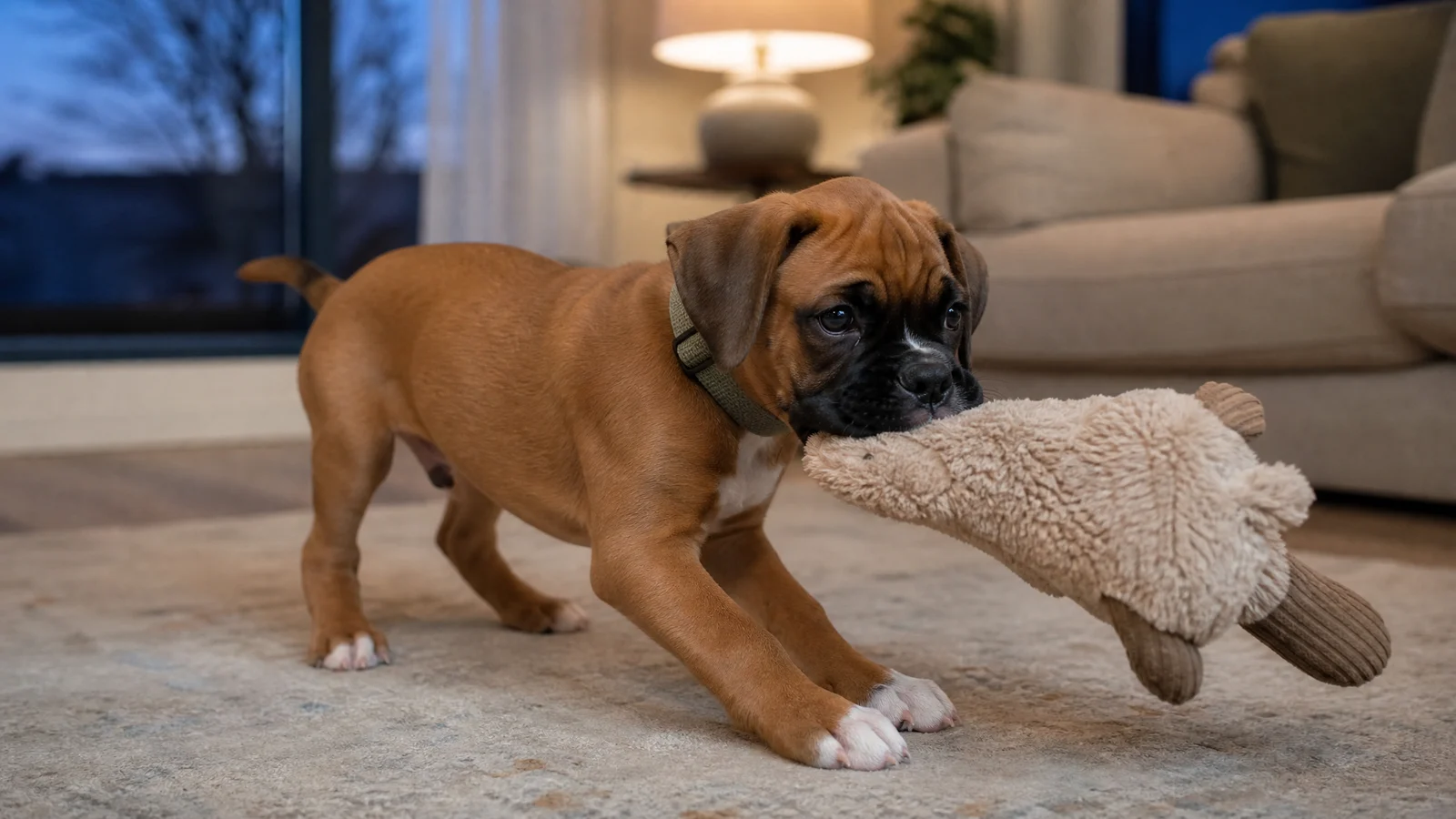
The scene is familiar to anyone who lives with a young Boxer. The puppy tears laps around the living room, skids, then lunges at a passing sleeve, locks on and tugs while the whole family laughs. It looks like comedy, but the mouth is doing serious work. A Boxer puppy explores and plays with their teeth the way you would use your hands, and their excitement climbs faster than their self-control can keep up.
This article looks at mouthy play in Boxer puppies, from grabbed sleeves, faces and tails to the evening frenzy, children and break routines. You will learn to set up your home to prevent rehearsed bites, reward gentle contact and end play calmly when teeth touch skin.
It matters because this breed is strong and playful. A puppy who learns that teeth buy a big reaction carries the habit into an adult body with real power, while a puppy who learns that gentle contact keeps the game going becomes a joyful companion.
Boxer Puppy Mouthy Play on Sleeves and Hands
Hands, sleeves, faces and tails all end up between the teeth of an excited Boxer puppy, and what they share is movement. Anything that flaps, swings or darts away reads as something to catch, and the breed's history as a chaser of wild game makes the grab feel natural.
Young Boxers also spend a great deal of time leaping about, so a dangling cuff at puppy height produces a jump and a bite in one motion. Face grabs usually happen when you bend down mid-bounce and your head moves into range.
Once the cloth pulls back, the tugging itself pays the puppy, which is why saying no rarely changes anything. The breed standard describes a lively, powerful dog, and a young Boxer with that engine has far more drive than steering.
Our work with this breed points to a fixed order: arrange the environment first and teach second, because every rehearsed bite makes the next one likelier. Arranging the environment means making the right target easier to find than the wrong one. Set the room before play starts:
- Place a chew toy at each doorway and play area, so you can offer one before teeth reach clothing.
- Skip loose cuffs, dangling drawstrings and flapping hems during play, because moving fabric works like a lure.
- Move your hands slowly and keep wiggling fingers away from the muzzle, since quick motion fuels grabbing.
- Choose games that keep the mouth on an object, such as a rope toy dragged low along the floor, instead of wrestling with bare hands.
- Pause petting when the mouth starts wrapping around your fingers, then resume once the puppy softens.
Boxers are clever but get bored with repetition, so rotate the toys and a fresh one will often beat your cuff. Management alone does not teach a soft mouth, but it cuts the number of hard-bite rehearsals and gives training room to work.
Mouthy Play That Peaks at Dusk
Many owners notice a daily rhythm. The puppy seems manageable in the morning, then turns into a land shark as evening arrives.
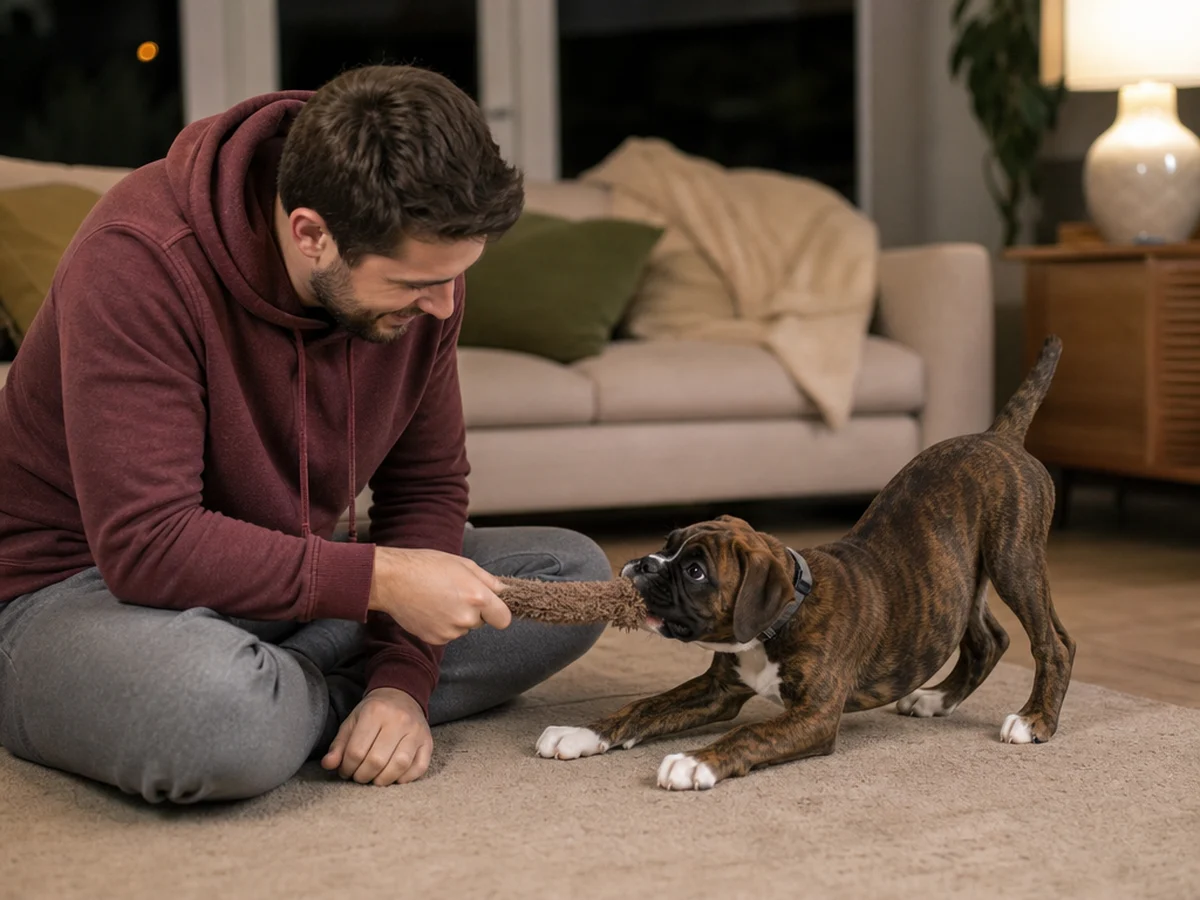
Part of the reason is that overtired puppies often mouth more, and by dusk a young Boxer can be tired, wound up and short on coping skills all at once. Add people coming home, dinner cooking and children back from school, and every moving ankle looks like an invitation.
Owners also describe an off switch in this breed. Boxers are bouncy and fast outdoors, then flop and snore once they are back inside.
That suggests the evening frenzy is not a fixed personality trait but a puppy who needs help reaching rest. We can't read a puppy's mind, yet the likeliest cause is that rest arrived too late, so the answer is rarely another round of play.
Move Rest Ahead of the Wild Hour
Shape the day around earlier rest. Put the big play and training in the morning and early afternoon, then offer a nap in a quiet pen or crate well before the usual wild hour.
Keep late-afternoon sessions brief and gentle, and hand over a long-lasting chew while dinner is being made so the mouth has a job while everyone is distracted. Reward the puppy for settling on a mat, so quiet becomes something worth earning.
With steady repetition the ankle and sleeve grabbing at dusk usually fades, even though the breed's energy stays high. If the mouthing ever seems sudden, painful or out of character, bring the change up during a routine veterinary appointment.
Why Does Your Boxer Puppy Bite Harder When Excited?
Arousal, meaning how keyed up the body and brain are, takes over steering as it rises. At a low level a puppy can feel your skin and ease off.
At a high level the same puppy is all momentum, and grip strength stops tracking what your hand can take. Boxers are playful and high in energy, so they reach that tipping point quickly. Chasing, wrestling, squealing and fast hands all push arousal upward, which is why a sweet puppy so often turns hard-mouthed in the middle of a game instead of at the start.
Spotting the Build-Up
Excitement rarely arrives all at once. Watch for faster movement, wiggling that turns into lunging, a higher-pitched growl and a mouth that stays on you instead of letting go.
These signs come before the painful bite, so they give you a window to act. Company seems to raise the level again.
Owners report that some Boxers jump around wildly whenever other people are present, even after repeated rounds of daily training. Expect faces and hands to be most at risk when a visitor leans in, and plan the room before the doorbell rings.
Responding in the Moment
Act while the puppy is still climbing, not after teeth land hard. Stop moving, fold your arms against your chest, turn your face away and slide a toy along the floor.
Reward the instant the puppy takes it, and keep your voice low and slow. If a hard bite does land, follow the ASPCA approach: ignore the puppy or step away for 10 to 20 seconds, then return and play again.
The puppy gets a clear message that play stays fun when it is gentle and stops when it hurts. Do not chase after them during the pause, because that turns the break into the next game.
Chew Toys for Mouthy Play
Many owners say their Boxer puppy grabs whatever is closest. That makes toy placement one of the most useful habits you can build, because the closest object should always be something the puppy is allowed to chew.
Where to Park the Toys
Mouthy play erupts in predictable spots, such as near the couch, by the door and around the kitchen, so stock those places first and the puppy's habit finds a legal outlet before it sets. Keep a toy at each hot spot and tuck another in a pocket during active play.
Then, when teeth head for your sleeve, a swap takes a second. Rotate a small collection, since a clever breed gets bored with the same item. Soft rope toys suit tug games that keep the mouth away from hands, firm rubber chews suit long calm chewing, and a stuffed chew helps when you need the puppy to settle.
Swapping Without a Tussle
A swap works best when you do it the same way every time. Keep the sequence calm and predictable:
- Stop the sleeve or hand movement so the chase part of the game ends.
- Place the toy at the puppy's mouth and mark the moment they take it.
- Reward with renewed play while the teeth stay on the toy, then pause again if they return to skin or clothing.
After enough repeats, many puppies begin reaching for the toy before they reach for the sleeve. That choice shows the replacement is becoming a habit.
Do Children Make Boxer Mouthing Worse?
Owners with kids report that children get mouthed more than adults do, and the reason is easy to follow. Fast, squealing, running play is exactly what lights up a bouncy puppy, and small bodies sit at face height.
Rules for Children
The breed's temperament is fundamentally playful yet patient with children, so the match is a good one, but a rowdy puppy can overwhelm a small child, and adults need to set the tone. Keep the rules few and clear so kids can follow them.
- Freeze hands and clothing when teeth arrive instead of pulling away and starting a chase.
- Keep faces away from the puppy during bouncy play and use a toy at floor level.
- Call an adult to trade in a toy or start a calm break when the puppy gets faster or harder.
Supervising Play
Rehearse the rules before the puppy joins the game. An adult should be in the room whenever the puppy and children play.
Keep sessions short and step in with a chew or a break before the puppy gets wound up, not after the first sore finger. If either side looks overwhelmed, separate them for a rest.
Praise the children for following the rules too, since calm kids and a puppy rewarded for soft contact make the mouthing ease sooner. For more on gentle play and meeting other dogs, read about teaching your Boxer to play gently.
Breaks Before Mouthy Play Spirals
The best moment to end a game is before the puppy overshoots, not after. A break placed early heads off the hard bites you would otherwise have to answer, and it resets a body and brain that are running hot.
A Break Before the Overshoot
Choose an early signal, such as the first burst of wild wiggling or a growl that sounds more intense, and treat it as your cue. Calmly stop the game, place a chew in front of the puppy and guide them to a pen or mat for a few quiet minutes.
The break should feel dull, not like punishment, so keep your voice flat and let the puppy come down on their own. When they are settled, start another short round.
Paying for Gentle Contact
Breaks show what ends play, and rewards show what keeps it going. Hold one hand flat and still with a treat in the other, and the instant the puppy licks or mouths softly, mark and reward.
Gradually wait for a lighter touch before you pay. This builds a soft mouth, meaning a dog who controls how hard they bite.
Watch the puppy's body too. Lip licking, pursed lips or yawning mean the exercise is asking too much, so return to an earlier step. Keep sessions short and vary the games.
What Progress Looks Like
Progress rarely means mouthing disappears. Expect the grip to get lighter, recovery after a break to speed up and the puppy to pick up a toy when your hands appear.
Mouthy Play Questions
Days with company or an overtired puppy will look like a step back, so judge by the trend over weeks instead of the worst evening. Once the routine settles, three practical questions usually remain.
Each answer points to the next useful skill. Will the same excitement make your puppy jump on guests? Quite possibly, because mouthing and jumping share a trigger around company, so practice with planned visitors and reward four paws down, as training a Boxer not to jump explains.
Does a watchful puppy mean a guard dog? Not necessarily, since many Boxers watch strangers closely without reacting, and protectiveness tends to appear only in particular situations, which the guard dog article covers. How should a wary puppy meet strangers? Let them sniff a hand and use gentle, high-pitched talk before any head pats, because wary Boxers often warm up within about 5 minutes when nobody rushes them.
What changes with maturity? Our Boxer age-by-age guide maps the skills that matter at each stage. Everything here comes back to what a Boxer is: playful, energetic, clever and eager to use their mouth.
Meet that need with toys within reach, short sessions, rest before the wild hours and rewards for gentle contact, and the puppy learns that softness keeps the fun going. Expect uneven days, celebrate small wins and stay consistent, because the lesson matters most once that mouth sits on an adult Boxer's much stronger body.
 Exercise and jobsBoxer Summer Play: Keeping Exercise Safe and Fun in Hot Weather
 Exercise and jobsBoxer Zoomies: Burst Energy, Speed and Recall Games
 CareVet Handling Training for a Boxer
