 Boxer
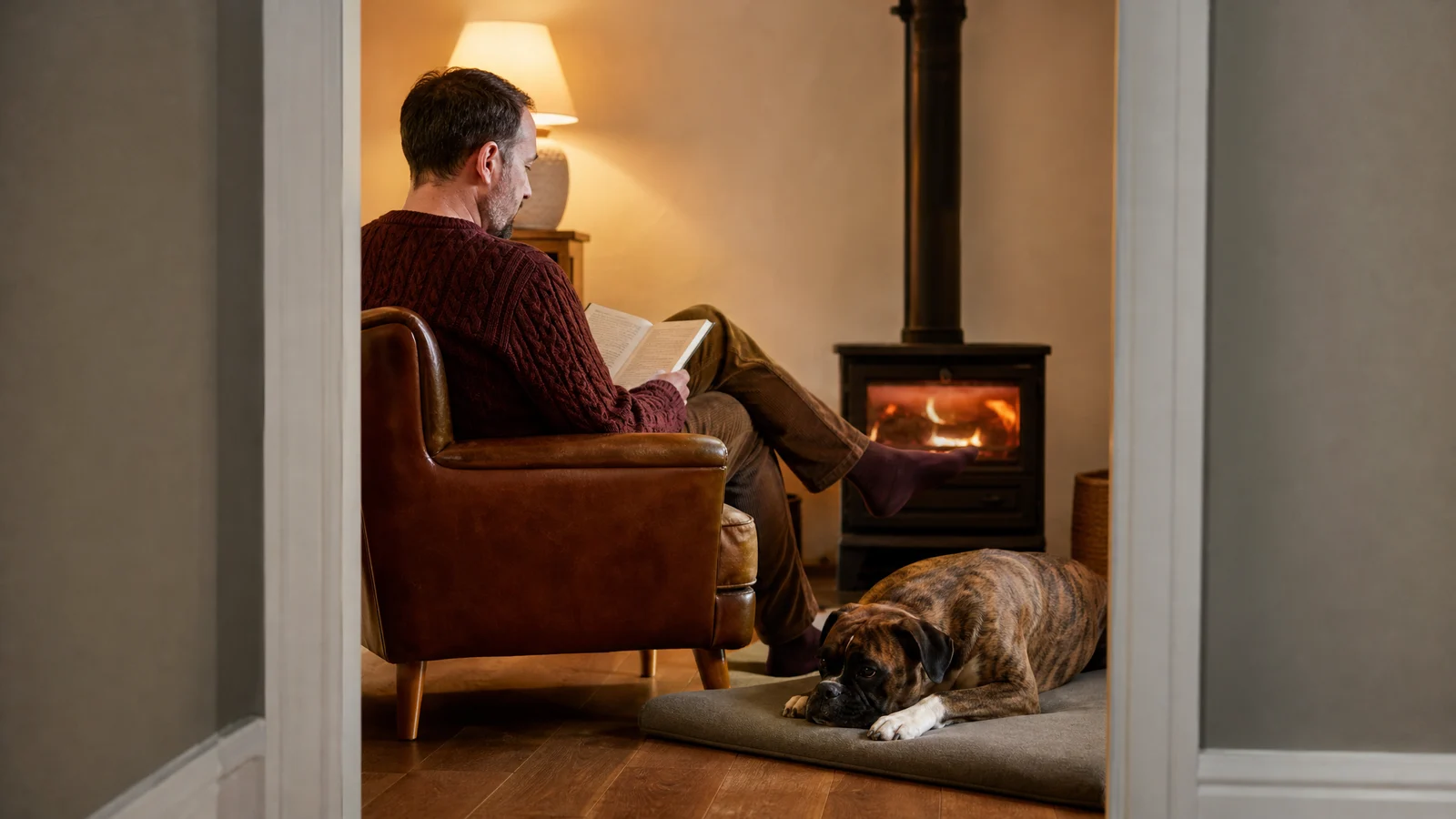
The months between a Boxer's first and second birthdays are when adult habits get laid down, and they are also when the bounce is hardest to ignore. Boxers do settle with time, but slowly and in uneven stages, and as a late-maturing breed they ask for a long view rather than a quick fix. Here you'll see what growth plates change about activity in year two, how to teach settling in three rungs and what to do when your dog boils over.
Two decisions cross nearly every owner's mind in this stretch, neutering and running, and both get honest answers after the first two sections. None of this needs special equipment. It needs a clear picture of what you are asking for, a spot in the house where asking is easy, and patience with a breed that matures on its own timetable.
What Unfinished Growth Plates Mean for Calm
Start with the one physical limit the breed comes with. The American Kennel Club puppy training timeline passes along a Boxer expert's caution: Boxers are a late-maturing breed with growth plates not fully developed until at least 18 months old, so extreme performance activities should be limited until maturity.
Read that line for what it says. It describes a skeleton, not a calm date, and it speaks of extreme performance work, not everyday play. In practice it means the hardest physical outlets sit further off than the first birthday suggests, so year two leans on thinking games and household manners. Our Boxer brain games guide has plenty of ideas, and the Boxer sports and jobs guide shows where working outlets can grow later.
The wider calendar, from the first weeks to the second birthday, lives in our Boxer puppy training timeline, and this page stays with what to do with the time you have now: teaching a dog who is very good at going to be just as good at stopping. Regular vet visits stay worth keeping up through year two.
A Ladder From Your Chair to a Calmer Boxer
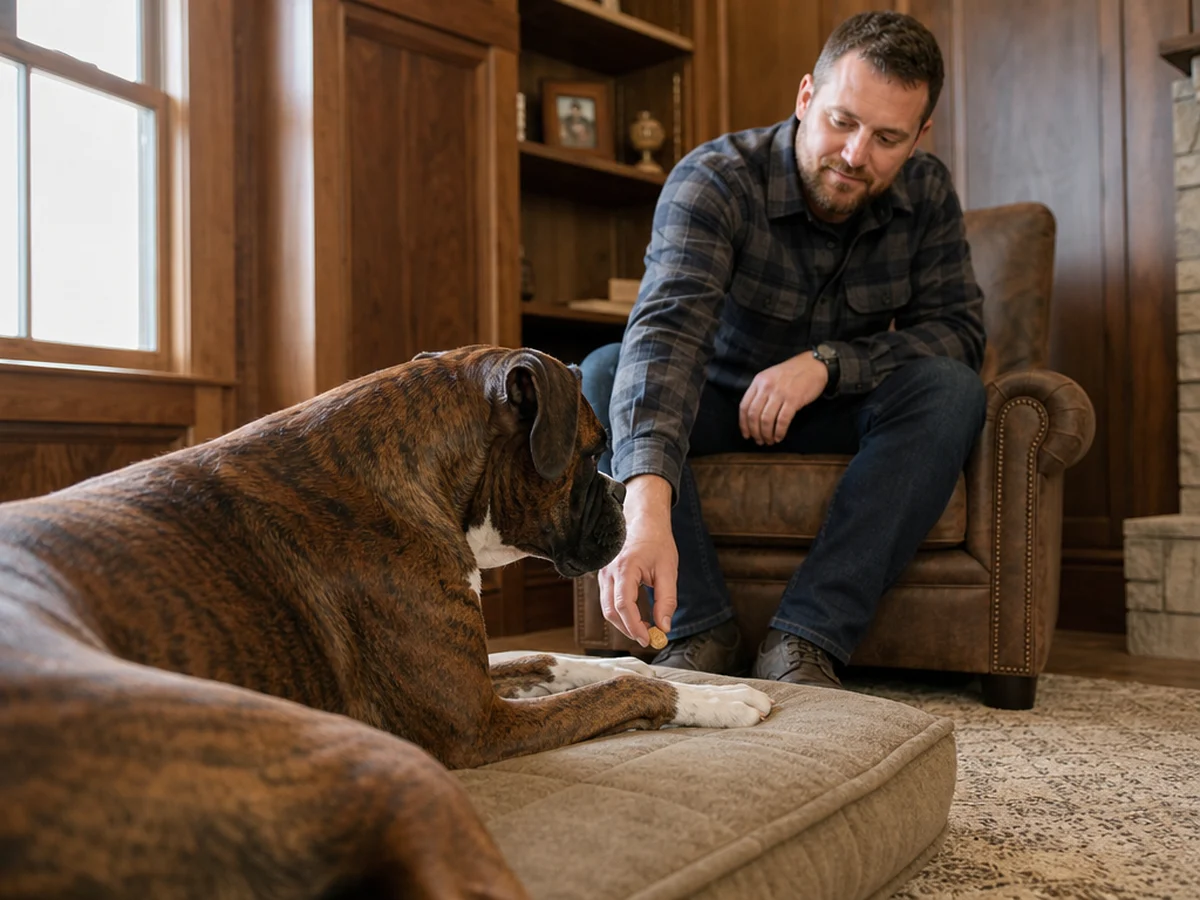
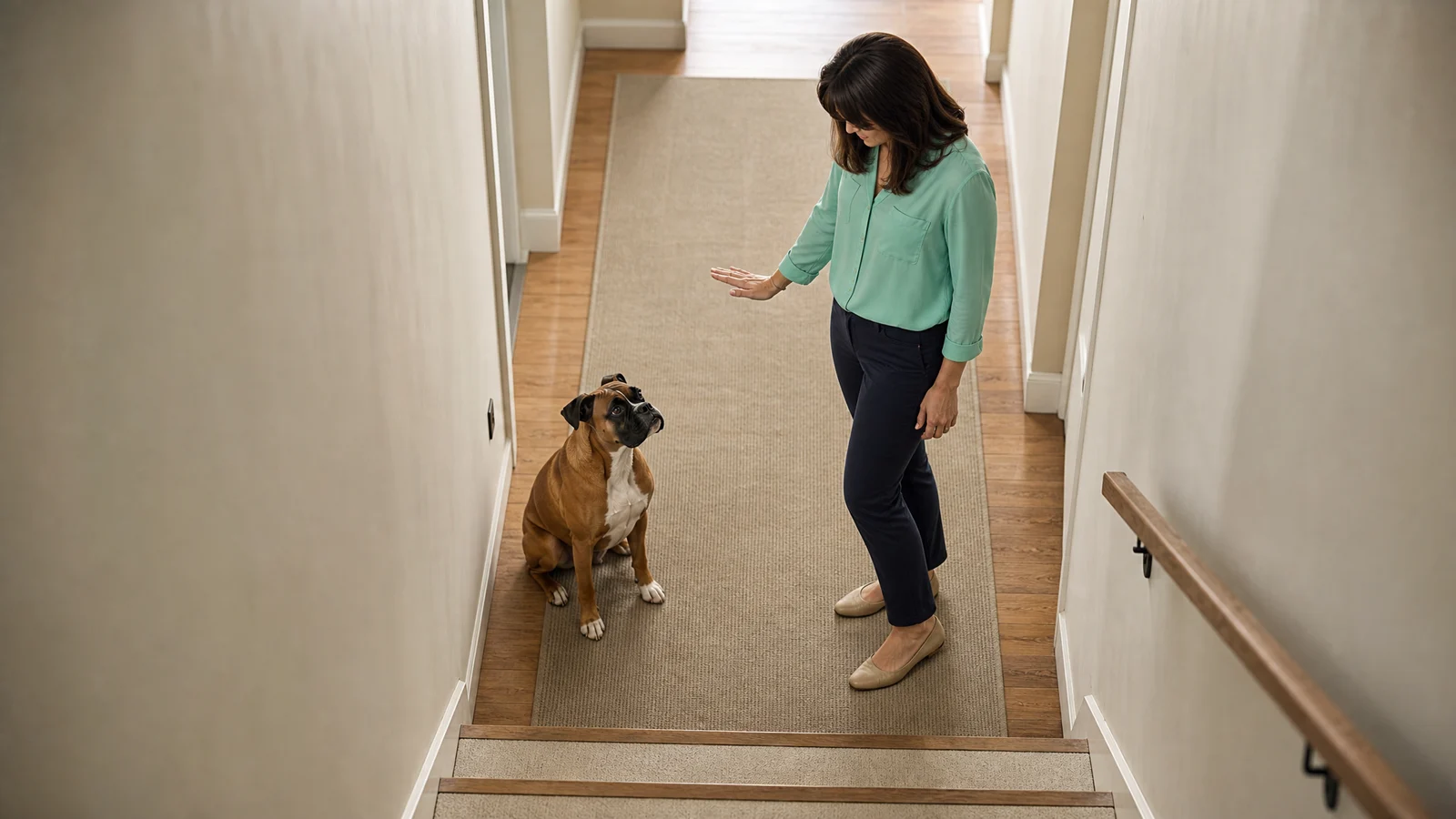
With the hardest outlets waiting, stillness becomes a skill worth teaching on purpose. Boxers are devoted to their people, so we like to start where the family already is and move away from there, instead of sending a young dog to a corner and hoping. Pick a mat or bed, reward your Boxer for lying down on it, then for staying, and release them with a word when you are ready. Climb these rungs only when the one below feels easy:
- Beside your seat. The mat sits within reach while you read, eat or watch something. Reward your dog for settling there, and again for staying put while you do nothing exciting.
- At the edge of the action. Move the mat to the kitchen doorway or a corner of the living room, where things happen near your dog but not to them. Reward the stay while people walk past.
- A little farther out. Move to a quieter spot, still in sight of you, with the busiest part of the house behind them. Reward the stay, and let it grow slightly longer between rewards before you ask for more.
Each rung asks for the same simple thing in a harder place, so if your Boxer pops up or wanders off, go back one rung instead of repeating the miss. The reward goes to the staying, not the arriving, and that is the part a bright, bouncy dog tends to skip.
Overlapping Phases in a Boxer's Second Year
Gradual phases mean overlap. A Boxer who lies on the mat like a veteran and still launches at the doorbell is not stuck, they are partway through two phases at once.
Even with the rungs in place, a second year rarely moves in neat stages. AAHA says the time between about 6 months and 3 years can be the most challenging for owners as the dog matures socially and behaviorally, and that developmental periods phase in and out gradually, so each dog should be approached as an individual rather than with a formulaic method. Measure the plan by what your own dog can do on the easier rungs, and add difficulty only when those hold.
When a Boxer Boils Over
Overlap also means some moments will outrun your practice. Watch for the build-up, a quickening pace, a fixed look at the door or a mouth that starts reaching for sleeves, because that is the cheapest moment to step in. We steer owners toward using the mat as the way out: cue the spot early, while your dog can still hear you, and give them something to do there, such as a chew.
If the moment has already peaked, end the activity, keep everyone safe and let your dog wind down without handling, scolding or a chase. Bursts of speed in the yard are a separate matter, covered in our Boxer zoomies guide, so use this section for the indoor, around-people kind.
Neutering and Running Decisions Around Calm
Two choices land on owners in year two, neutering and running, and the answers below stay with what each one can and cannot do for a Boxer's calm and where your own dog's situation takes over.
Will Neutering Make My Boxer Calmer?
The Merck Veterinary Manual says roaming, mounting, urine marking and fighting are stimulated by sex hormones, particularly testosterone, and that these problems are often greatly reduced in males by neutering. Bounce, mouthiness and plain enthusiasm are not on that list, so training still does the work there. Whether neutering is right for your dog, and when, is a decision for your vet.
Is Running With My Boxer a Good Idea?
The veterinary school at UC Davis includes Boxers among popular brachycephalic breeds and notes that these dogs may have trouble panting enough to cool off in hot, humid weather, especially when exercising. They still need exercise, but it is important to avoid overexertion, especially in hot weather. Whether a running routine suits your Boxer, and how far, is a question for your vet, and our Boxer hot-weather guide covers summer play.
This page is general information, not veterinary advice. Check with your vet about neutering, running and anything else that touches your own dog's health.
Making the Mat the Calmest Seat in the House
Everything above rests on the mat being a place your Boxer likes, so give it a little marketing. Scatter a few bits of food or tuck a chew onto it now and then while your dog is elsewhere, and let them find it. A mat that keeps turning up good things becomes the spot they drift toward, which makes every rung easier to climb. Our free Boxer training e-book puts the full picture in one place, broad enough for every stage and skill, in plain language.
 BehaviorTraining an Older or Adopted Boxer
 Training basicsHow to Teach a Boxer to Sit
 Training basicsHow to Teach a Boxer to Stay
