 Boxer
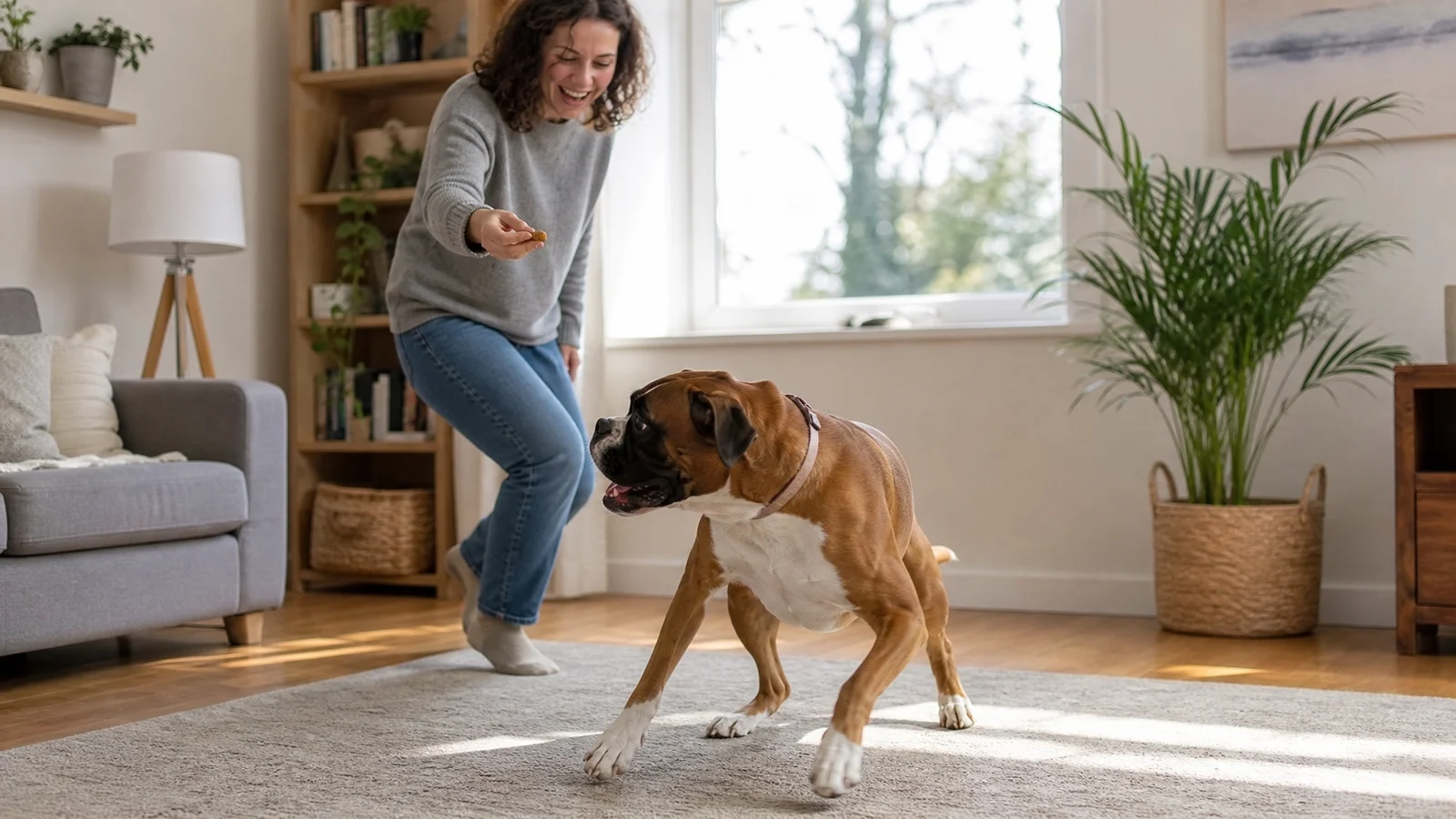
The AKC rates Boxer trainability 4 of 5 and calls the breed highly intelligent, a strong problem solver with a mind of their own, and quick to bore with repetition. In practice, that combination tends to produce a Boxer who learns a new cue in a few minutes, then wanders off, clowns around, or invents a better game than the one you planned.
That gap matters because a quick mind left without work finds its own, usually as chewing, barking and laps around the sofa, while a dog trained well gives back an attentive, funny partner who settles happily afterward. Below, you'll find the working principles that fit this breed, including short sessions, rotating rewards, shaping games, a diagnosis for mid-session tune-outs, and what changes as your Boxer grows up.
Short Training Sessions Beat Repetition
A highly intelligent breed like the Boxer picks up new cues quickly, and that is exactly where the trouble starts, because the same sit asked for yet again earns a dog who looks past you at the couch, the window, or the nearest toy. Repetition drains interest quickly in a breed this clever, which is why a session of a few minutes, stopped while the dog is still keen, teaches more than a long one that ends in a sulk.
Timing should also follow the dog's own rhythm. Many owners describe a Boxer who lounges or sleeps roughly 20 to 22 hours a day and spends a short daily window on zoomies and wrestling, bouncy on walks and then flopped and snoring once back indoors. Train in the minutes after that bounce begins to settle, or after a walk, when the dog is awake and willing but no longer launching off the furniture.
Energy also differs between individual Boxers, from day to day, and with the season, so the plan is a loose frame and not a clock. On sleepy days keep sessions even shorter and gentler, and on wild days let a walk or a game of fetch or tug come first.
A Sample Week of Short Sessions
The plan below is a frame to adapt, with several sessions of a few minutes each tucked between walks, meals and naps. The skills are reshuffled so nothing repeats back to back.
| Day | Skills in rotation | Pay |
|---|---|---|
| Monday | Name game, lured sit, mat settle | Soft treats and a scatter of food |
| Tuesday | Hidden-treat search, short recall, down | The find, then praise |
| Wednesday | Four-paws greeting with a helper, touch | Attention from the helper |
| Thursday | Tug with a stop cue, sit, mat settle | The tug toy |
| Friday | Recall in a new spot, loose-leash steps | Treats and a quick chase game |
| Weekend | One old favorite plus one new trick | Whatever the dog picks that day |
Reshuffle the order and the pay the following week. A session that stops early leaves a Boxer asking for another round, and that wanting is the most useful thing you can build.
Variety in Rewards Keeps Training Fresh
Food is the usual starting point, but a reward that arrives the same way every time slowly turns into background noise, and a clever Boxer notices that sooner than most. Rotating what you pay with, and changing the exercise it follows, keeps the next treat or game worth working for. Find out first what your own dog values, since individuals differ and the same dog may want something different on a sleepy day than on a wild one.
Rotate the Pay
These options cover most of what a Boxer will work for. The best results come from mixing them within a single session.
- Small, soft treats can be delivered in an instant, which suits a dog who loses interest fast, and part of a meal can go on a snuffle mat as a longer-lasting reward.
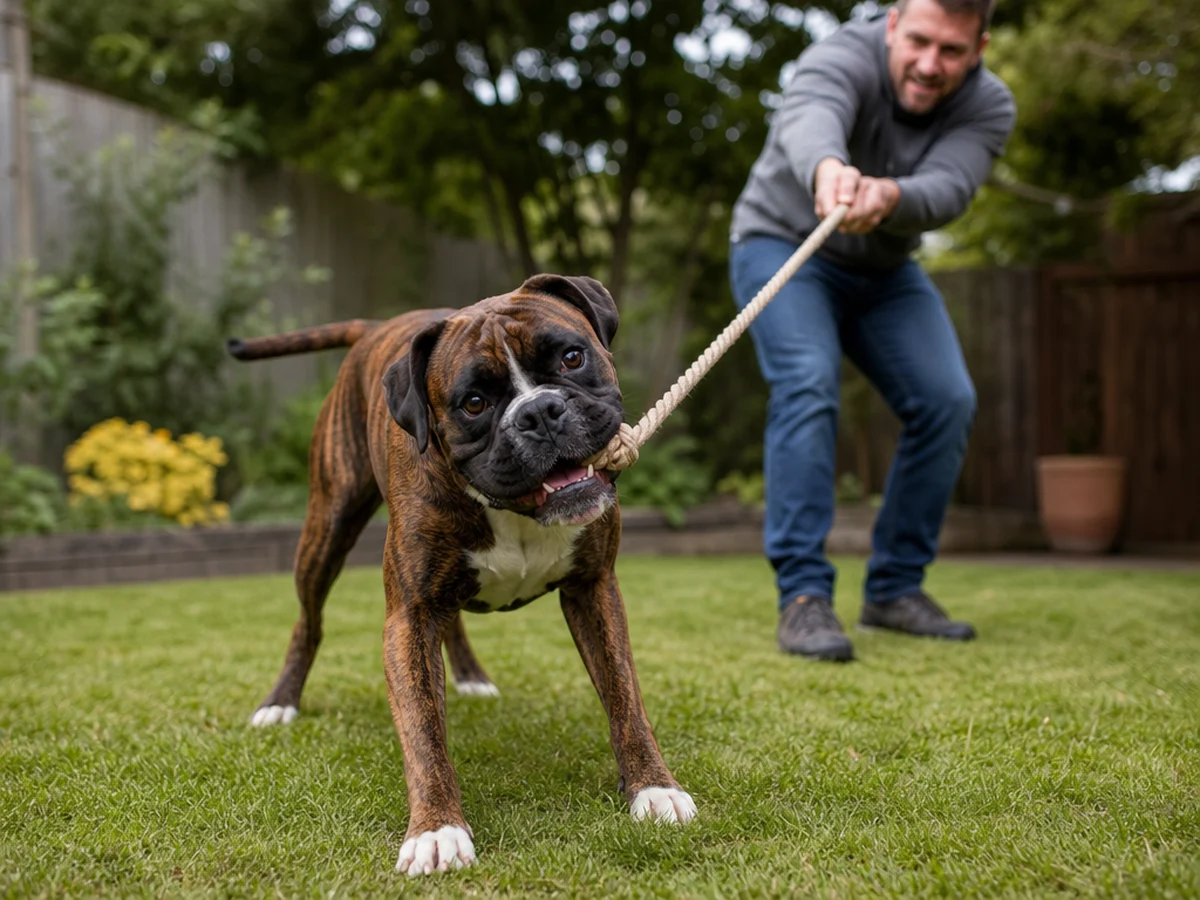
- Tug is a strong reward for a playful dog as long as the game has a clear start and a clear stop cue, and fetch does the same job in a yard or even down a hallway.
- Toys that live out of sight and appear only for training or play stay far more exciting than a permanent pile, a habit some owners rely on.
- Praise and a scratch on the chest matter to a breed that is affectionate with family and happiest close to them.
- Life rewards such as the door opening, the leash clipping on, or a greeting with a friend can all be earned with a sit.
Vary the exercise as well, so the sit that earned a treat in the kitchen earns a tug game in the hallway and a hidden-treat search outside. The aim is a dog who never quite knows which good thing is coming, only that something is.
Charging a Marker Word
A marker word tells the dog the exact moment they earned the reward. It takes only a few short rounds spread across a day to build.
- Pick one short word such as yes, say it brightly, and hand over a treat within a second.
- Repeat in different rooms until the dog's ears lift and their head turns at the sound alone.
- Begin marking the instant of a behavior you like, such as a glance at you or four paws on the floor, since young Boxers need constant reminders to stay down.
- Say the word first and pay second, every time, so the word always predicts the payment.
- Once the marker is solid, mark the behavior and then choose the reward: a treat, a tug game, or a release to play.
Because the marker is separate from the reward, you can pay with food once, tug the next time, and a romp after that, which is what keeps the pay unpredictable.
Let a Problem-Solving Boxer Think
Because Boxers are strong problem solvers with a mind of their own, the best lessons are the ones that let the dog work something out, and shaping is the cleanest way to do it. Instead of luring every position, you wait, mark each small step toward the goal, and let the dog discover the rest. That suits a breed that would sooner experiment than obey on autopilot.
A mat settle shows the pattern. Mark a glance at the mat, then a step toward it, then a paw on it, then all four feet, then lying down, paying a little more for each improvement. A Boxer who found the answer on their own tends to remember it and to offer it again hopefully, which is a habit worth encouraging, since offered behavior is the start of nearly every trick.
Puzzle-Style Lessons
Thinking games extend the same idea beyond cues, and they tire a clever dog in a way that more drilling never will. Owners find that a few kinds of mental work occupy a Boxer reliably, even in a small home.
Hidden-treat searches work well, starting with an easy find in plain sight and moving to treats tucked behind furniture or in another room. Snuffle mats used with part of a meal turn dinner into a short job, and tough wand toys that move unpredictably add variety when you pair them with a clear start and stop. You can also hide toys around the house and bring them out one at a time for play.
Our guide to Boxer exercise and brain games has more ideas for pairing physical outlets with mental work. Offer a puzzle in place of a drill, and the same intelligence that wanders off during repetition turns up working for you.
Why Does Your Boxer Tune Out Mid-Session?
Tuning out has more than one face, and the right response depends on which one you are looking at. Three causes account for most of it in this breed, and each has a quick remedy that costs you nothing but a change of plan.
What Causes the Tune-Out
Boredom looks like slowing down: the sits arrive later, the eyes slide away, and the dog starts sniffing the floor or drifting toward a toy. In a quick learner it usually means the exercise was understood a while ago.
Over-excitement looks like the opposite, with spinning, mouthing, jumping and a dog who seems unable to hear you. Playfulness and energy both run high in this breed, so a session begun at peak bounce is mostly spent managing the bounce.
Then there is the clown, who offers a play bow, a spin, or a toy delivered in the middle of a cue. That is the mind of their own at work, a dog proposing a better game, and it is rarely a refusal. Barking mid-session deserves a second look too, since Boxers are not a nervous breed and do not bark without cause, which usually points to boredom or impatience for the reward.
Quick Fixes That Work
Match the remedy to the cause. Expect to try more than one in the first few days.
- Shorten the session and end on a success before the drift begins, rather than pushing for one more repetition.
- Change the exercise, the room, or the reward instead of repeating the same request in the same way.
- For an over-excited dog, burn off the first rush with a walk or a game of tug, then settle on the mat before asking for anything harder.
- Treat goofing as information: pay for one quick cue, then release the dog into the game they proposed.
- For boredom barking, add scent games, short training bursts, or puzzle feeders so the dog has work to do.
Calm, Reward-Based Training for a Boxer With Opinions
A smart dog with a mind of their own does best when training feels like a conversation. The breed standard calls the Boxer's temperament steadfast and tractable, which describes a dog who cooperates readily when the work makes sense and the pay is good.
Calm, reward-based handling keeps the dog loose and curious. They keep offering behaviors and treat a mistake as a puzzle to solve, and a Boxer who wants to be near their people stays close and keen to work. When something goes wrong, the consequences stay mild and quiet.
You can pause the game for a moment and let the dog settle, or calmly interrupt and then ask for an easier cue that you can reward right away. If mouthing or jumping gets out of hand, end play for a short time-out, then restart the game calmly once the dog has caught their breath.
Management carries a surprising share of the work with an exuberant breed. A gate across the doorway, a leash at the front door, and shoes put away mean the dog gets fewer chances to practice the wrong thing and you get more chances to pay for the right one.
Can Training Continue Past the Puppy Years?
It can, and the later years are where a Boxer's training pays back most, since the dog you taught as a puppy now has the body and the attention to do more.
Early socialization and puppy classes are vital for channeling the breed's exuberance, but classes and short sessions stay useful well beyond that stage, and an adopted adult can start learning right away. Owners of newly adopted dogs often report that the wildness faded within a few weeks of routine and training.
What Changes in Adolescence
Adolescence often arrives as a puzzling regression, with a sit that was solid in the living room vanishing in the hallway or on the sidewalk. Go back a step instead of repeating louder: ask in an easy spot, pay well, and then raise difficulty in small steps of distance, duration and distraction.
Keep the marker, the mat and the short sessions, because those are what carry the dog through, and keep exercise generous, since a restless adolescent Boxer is harder to teach than a pleasantly tired one.
Refreshing Old Cues
A cue the dog has known for months still needs a reason to be interesting. Small new twists restore it.
- Ask for a sit while you are moving, then while the dog is moving, then at the end of a short run.
- Send the dog to the mat from across the room, and later from another room.
- Follow a recall with a hidden-treat search so coming to you leads to a game.
- Chain two cues before the marker, such as a down and then a touch, and pay for the pair.
- Join a class in a new skill such as rally, agility, or nose work to give the old cues new company.
What Boxer Training Looks Like After Year Two
Many owners find the long view is gentler than the early months suggested. Wild energy often eases with maturity, routine and training, and the rowdy youngster slowly becomes the dog who plays hard outdoors and then flops, snores and lounges inside. The change comes gradually, with sleepy and wild days still mixed together, so a steady routine matters more than any calendar.
Progress is steady but not a straight line. Expect a stubborn stretch now and then, usually after a change in routine or a run of dull days, and treat it as a prompt to shorten sessions, change the rewards and add a fresh game. The clownish streak also persists, so a play bow in the middle of a cue at an older age is part of the dog and not a setback. Pay for the cue, then let them have the joke.
A Boxer stays trainable for life when practice stays regular and short. As the years pass, sessions get gentler, since older Boxers cannot match younger dogs' pace, and regular veterinary checkups are worth keeping.
This is general information, not veterinary advice. If a reliable cue suddenly falls apart, or your Boxer seems stiff, tired, or unlike themselves, check with your veterinarian before assuming attitude, because discomfort can look like stubbornness.
With short, varied, reward-based practice, a Boxer's cleverness becomes reliability over the years, and what you keep at the end is a partner who still looks up for the next bit of work, with the playful mind of their own never quite disappearing.
 BehaviorIs a Boxer a Good Guard Dog?
 Training basicsLeash Training a Boxer: Pulling, Lunging and Loose-Leash Walking
 BehaviorTeaching Your Boxer to Play Gently With Kids and Meet Other Dogs
