 Boxer
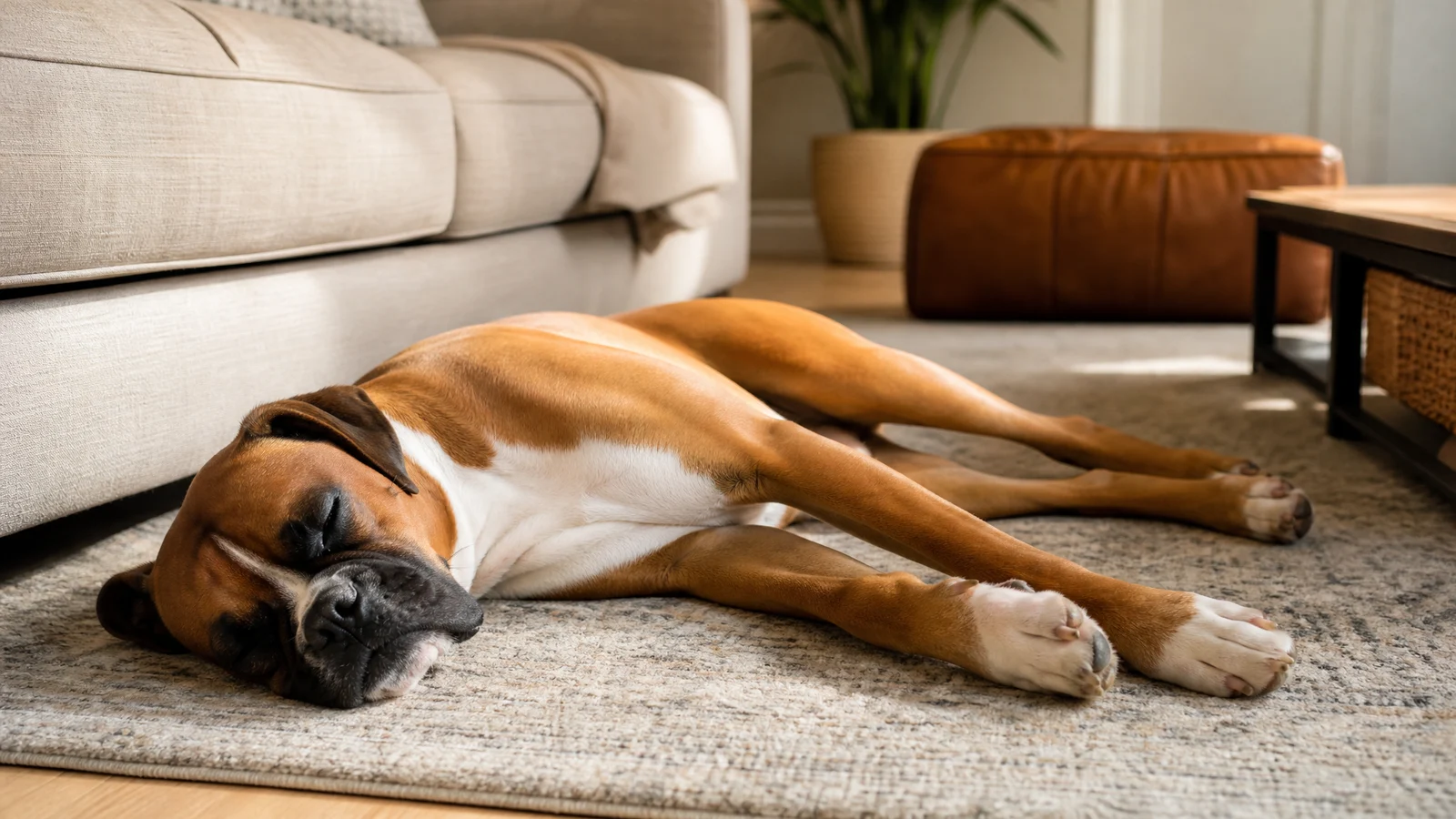
Two Boxers can live in very similar homes. One gets a solid daily outing plus a few minutes of hunting for hidden treats, then flops beside the couch and snores through the afternoon. The other gets a lap around the block and spends the evening chewing the sofa and gouging the door frame. Owners describe both dogs, and the gap between them usually lies in the plan rather than the dog.
This article covers Boxer exercise for four kinds of households: small city apartments, families raising young children, homes that already have another dog, and owners who are out at work all day. The aim is to help you fit walks, play and thinking games to your own home, so most days end with a calmer dog. Our work with this breed keeps pointing to one pattern. A clever dog with spare energy invents a job, and rarely one you would choose.
What an Energy Rating of Four Means for Exercise
Ask owners about energy and they describe two quite different Boxers. Many have a dog who sleeps or lounges for most of the day, roughly 20 to 22 hours by their count, and saves one short window for zoomies (sudden bursts of full-speed running) or wrestling. A smaller group has a dog who handles runs and hikes of 14 to 20 miles without seeming tired.
Both descriptions fit the published ratings, which put the Boxer at four on a five-point scale for energy level and four for mental stimulation needs. At the top of the mental scale, five, sits the dog who is happiest with real work to do. The breed's standard says the movements denote energy, and the UKC breed standard describes a gait alive with energy.
A four explains the switch owners notice between settings: bouncy and fast outdoors, then flopped and snoring once back inside. The energy is real but arrives in bursts, so it needs a daily outlet. Because the mental rating is just as high, legwork alone meets only half the need. A bored, clever dog tends to fill the gap with chewing and door-frame damage.
The four households below differ, but the same frame sits under all of them. Treat it as a starting point rather than a quota:
- For a healthy adult, plan on an hour or two of total activity spread across the day. Some breeds need that much, and working breeds need significantly more. The Boxer belongs to the Working Group.
- Count thinking work as part of that total, because a scent search or puzzle meal tires the brain in a way a lap around the block does not.
- Follow your own dog. Energy differs between Boxers in the same home, from day to day, and by season, so let the individual in front of you set the plan.
- End play while your dog is still keen and put the toy away, so every session finishes on a good note.
Puppies and older dogs need gentler versions of this frame, and regular veterinary visits help you tune it to your dog's age, joints and heart. Owners also report that maturity, routine and training settle even very energetic Boxers, and that a newly adopted dog's wildness often fades after a few weeks. The timing varies, so judge by your dog rather than a birthday.
Apartment Boxer Exercise Without a Yard
In an apartment, a Boxer's day tends to run on a clock. Owners who keep apartment dogs settled describe schedules from twice-daily half-hour walks to a walk every two hours with play in between, and some add long walks and off-leash training in a safe, enclosed space. The common thread is that the outdoor window arrives predictably.
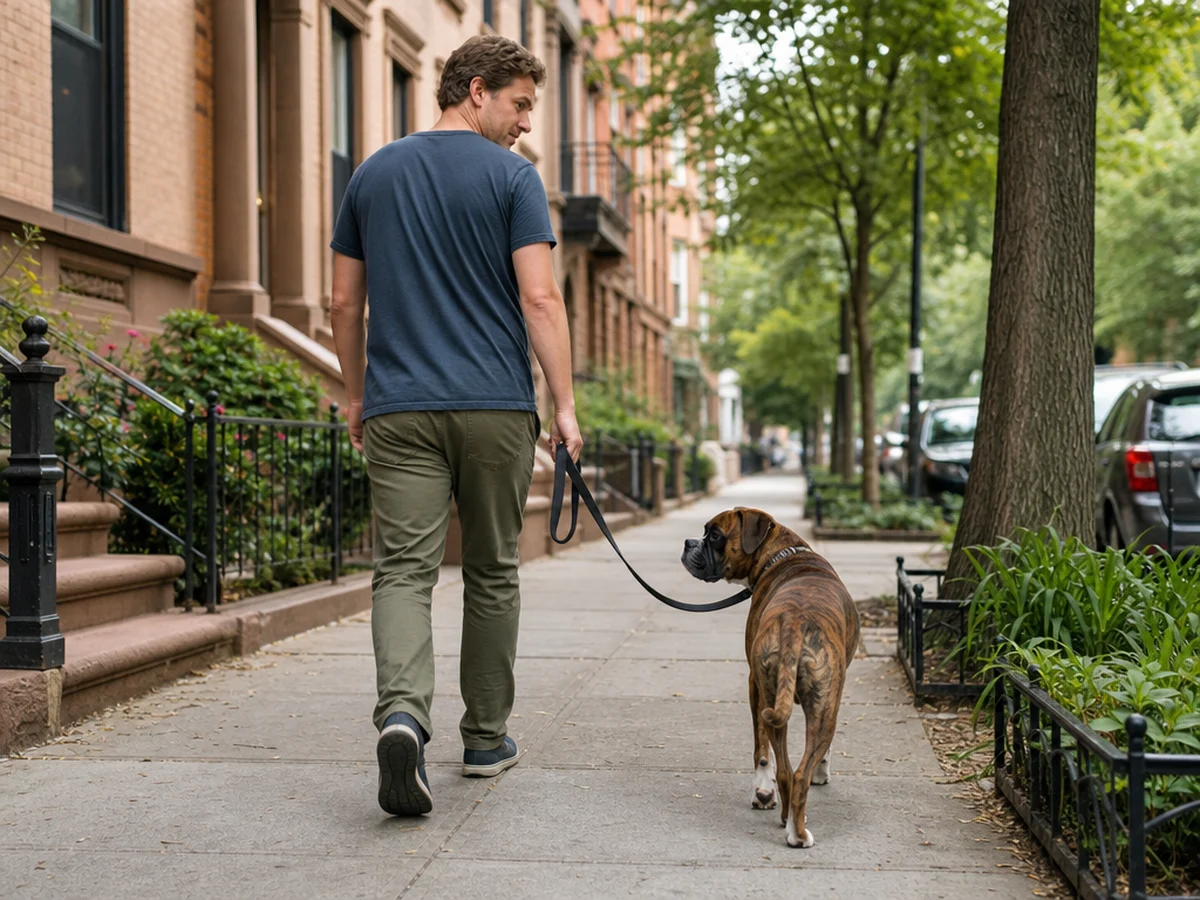
Predictability matters because of the switch between settings. A Boxer who knows the next outing is coming can flop and wait. A dog with irregular outlets lets the energy leak out indoors as pacing, mouthing and chewing. A yard is convenient, but grass alone does not tire a dog, and a dependable schedule can do the same job without one.
Indoor outlets fill the gaps between outings. Use whichever fit your layout:
- Fetch and tug with a tennis ball or a tough wand toy along a hallway with solid footing, which owners use to burn energy even in small spaces.
- A calm walk up and down the building stairs for an adult dog, taken at your pace rather than as a race. Check a young puppy's stair use with your vet first.
- Meals on a snuffle mat (a fabric mat with strips that hide kibble) or scattered across the floor, so the dog hunts for dinner.
- Toys rotated out of sight and brought back later, which keeps familiar toys interesting.
Neighbors add one more consideration. Because of the breed's history as a chaser of big game, Boxers spend a good deal of time jumping and leaping about when young, and they need constant reminders to keep all four paws on the floor. Reward paws on the floor in the hallway and at the door, and you protect the people downstairs as well as your own shins. The breed is moderately adaptable, which fits the pattern. Apartments work when routines are dependable.
Exercise Plans for a Boxer Among Young Children
In many family homes the afternoon goes the same way. The children come in the door, the Boxer meets them with a bouncing, full-body welcome, and within minutes the living room is a wrestling ring. Nobody means harm, but a powerful, playful dog and a small child are a combination that needs structure.
The standard describes the Boxer as playful with family yet patient and stoical with children, and the breed earns top marks for being good with them. Even so, the breed's own descriptions caution that a powerful, active Boxer may not suit a small child who could be overwhelmed by a bouncy puppy. The cause is size and exuberance, not temper, so the fix is to spend the energy before the children and the dog collide.
That means an adult owns the exercise and the children get supporting roles. A plan that works for many households:
- Take the main walk or fetch session before the busiest part of the afternoon, since a dog who has already run and sniffed bounces less at a small child.
- Let children do calm jobs under your eye, such as tossing a handful of treats on the floor for a search or asking for a sit before a toy comes out.
- Keep tug and wrestling-style play adult-run, with a clear start and a clear end, so the game does not escalate on its own.
- Give the dog a bed or gated area to rest undisturbed. A tired Boxer may turn irritable, and children should learn to leave a resting dog alone.
Supervision holds all of this together. Reward calm paws near children, and use a calm interrupt, such as pausing the game and asking for a sit, whenever excitement climbs. Children do not need to wear the dog out. Relying on them to do it tends to link small people with the wildest play, which is the opposite of what you want.
A Two-Dog House Splits Exercise by Temperament
In a two-dog home, one dog is often at the door with a ball while the other watches from the couch. Owners with an older and a younger dog report that the older Boxer cannot match the younger dog's activity or demands, and that a tired older dog stops keeping up. Even Boxers of similar age differ, because energy varies by individual.
When both dogs get identical exercise, one is under-served and the other is worn down. Matched play also feeds on itself, with wrestling getting louder and rougher as excitement rises. Boxers are not always tolerant of dogs of the same sex, while most opposite-sex pairs enjoy each other, and the breed's rating with other dogs is a middling one that assumes supervision. So the plan is part split and part shared.
Where to Split the Outings
Give the higher-energy dog their own run, fetch session or longer walk, and give the slower dog a shorter, sniff-heavy outing at their own pace. Owners report daycare and playdates with compatible dogs, including similar-energy or larger dogs, as dependable ways to take energy out of the livelier one. Brain games also work separately, since each dog can search for treats in a different room.
Where to Share Them
A slow sniffing walk side by side suits both dogs and keeps them comfortable in each other's company. For indoor play, keep sessions short and use a calm interrupt the moment arousal climbs.
Call both dogs away from the game and ask each for a sit. Reward calm, then give a short rest before anything restarts. Resume only when both look relaxed, or end the play for now.
Dog parks are a mixed bet here. Some owners find the park wears a Boxer out more than a walk, while others avoid it because of fights. A playdate with a known, compatible dog gives you the same exercise with fewer surprises.
Long Workdays and the Boxer's Exercise Gap
A Boxer who has been alone all day often greets you as though the day is just starting, and the evening can swing wild if nothing has used up the day's energy. Daytime sleep is normal for the breed, since many Boxers lounge for most of the day. The real gap is not the hours alone but the time spent awake with nothing to do.
That cause points to the fix. A bored, clever dog invents entertainment, sometimes with noise, and for boredom barking, scent games and puzzle feeders are the usual remedy. Build the day around the windows you have, and put enrichment into the hours you do not:
- In the morning, give a walk with plenty of sniffing, then serve breakfast from a snuffle mat or puzzle feeder so the dog works before you leave.
- Right before you go, hide a few treats and put out one rotated toy, so the first stretch alone is occupied.
- If you can, add a midday outlet such as daycare, including vet-run daycare, which owners call a reliable way to take energy out.
- In the evening, play fetch or tug, then walk, and finish with a short search game so the dog settles.
The tempting mistake is to save everything for one long weekend outing. Fitness builds gradually, so increase distance over weeks and call your vet if your dog tires quickly or limps. Steady daily outlets suit this breed better than occasional marathons, which build stamina without teaching the dog to wait calmly.
Brain Games That Count as Exercise in Any Home
A Boxer who comes home from a long walk and keeps pacing the kitchen is a familiar sight, and a short round of hunting for hidden treats often finishes the job the walk did not. The reason is that Boxers are highly intelligent, excellent problem solvers who tire of repetition. A loop walked at the same pace uses the legs while the mind sits idle.
Scent work is the simplest fix. Nose work suits almost any dog, including older or physically limited ones, and it helps high-energy dogs learn to focus. Puzzle feeding and short trick sessions add variety. Spend a few minutes teaching a spin or a settle on a mat for treats. Short and varied beats long and repeated, and our guide to training a smart Boxer covers how to keep sessions fresh.
Each home leans on a different mix, as this table shows.
| Household | Best brain game | Why it fits |
|---|---|---|
| Apartment | Snuffle mat and hidden-treat search | Works in a few square feet and tires the dog between outings |
| Young children | Supervised treat toss and sit before play | Gives children a calm job that does not stir up wrestling |
| Two dogs | Separate searches in different rooms | Lets each dog work at their own level |
| Long workdays | Puzzle breakfast and a pre-departure hide | Occupies the first stretch alone |
Because these games ask little of the joints, they also suit puppies and older dogs. They help most on the days when weather or schedule cuts the walk short.
Today's Boxer Exercise Starts With One Thinking Task
Look at tonight in your own home: the walk you already planned and the dinner already measured out. Each has room for a small thinking task, and that addition is the piece many Boxer routines are missing, because the legwork is usually already there.
Choose one and do it today, at the next mealtime or on the next walk. A scatter feed means tossing the meal across the floor or a patch of grass so the dog sniffs it out. A find-it game uses a few treats instead.
Show your dog a treat, say find it, and drop it where they can see it. Next, hide a few treats in easy spots, in one room or along the first stretch of the walk. Praise each find, and make one spot a little harder if your dog succeeds quickly.
Stop while your dog is still keen, then carry on with the walk or the meal.
Notice how your Boxer behaves afterward. If they settle faster, flop, and leave the sofa alone, you have found what the routine was missing. Repeat it daily, change the hiding spots, and let it grow into the larger plan your household needs.
 Training basicsHow to Potty Train a Boxer Puppy
 Training basicsBoxer Dog Training Built Around a Smart, Easily Bored Dog
 BehaviorIs a Boxer a Good Guard Dog?
